Feathers, Sweaters, and Better Weather: A Short Look at the Big Picture of Bird Migration

November 18, 2020

Written (and photos) by Gregor Yanega

I invite you to consider bird migration, and how it is simultaneously subtle, regular, and large in scale. Imagine the cold air as it sinks into the furrows of the watershed under the stars while a few puffy clouds scoot across the moon like children late to dinner. Small squadrons of quick, black dots, darker than the night sky, flap from silhouetted barn to field to wood in little flocks, stretching out and clotting together before disappearing up the tree-cloaked slope of the far hillside. There are pulses to the quiet caravans of birds. The more you look, the more they appear, driven sideways like ash or snow – these siskins, finches, and juncos. You hardly hear anything unless you strain for the sound. Single notes quail in the night. Little pips and boops drift down in a soft sonic rain, in all that remains of their passage. Migration is both visible and invisible, the way icebergs are in the arctic: remarkable yet expected, seen, yet underestimated. So much goes on when we are not looking, when it is too cold to stand there much longer, when it is too dark to see.

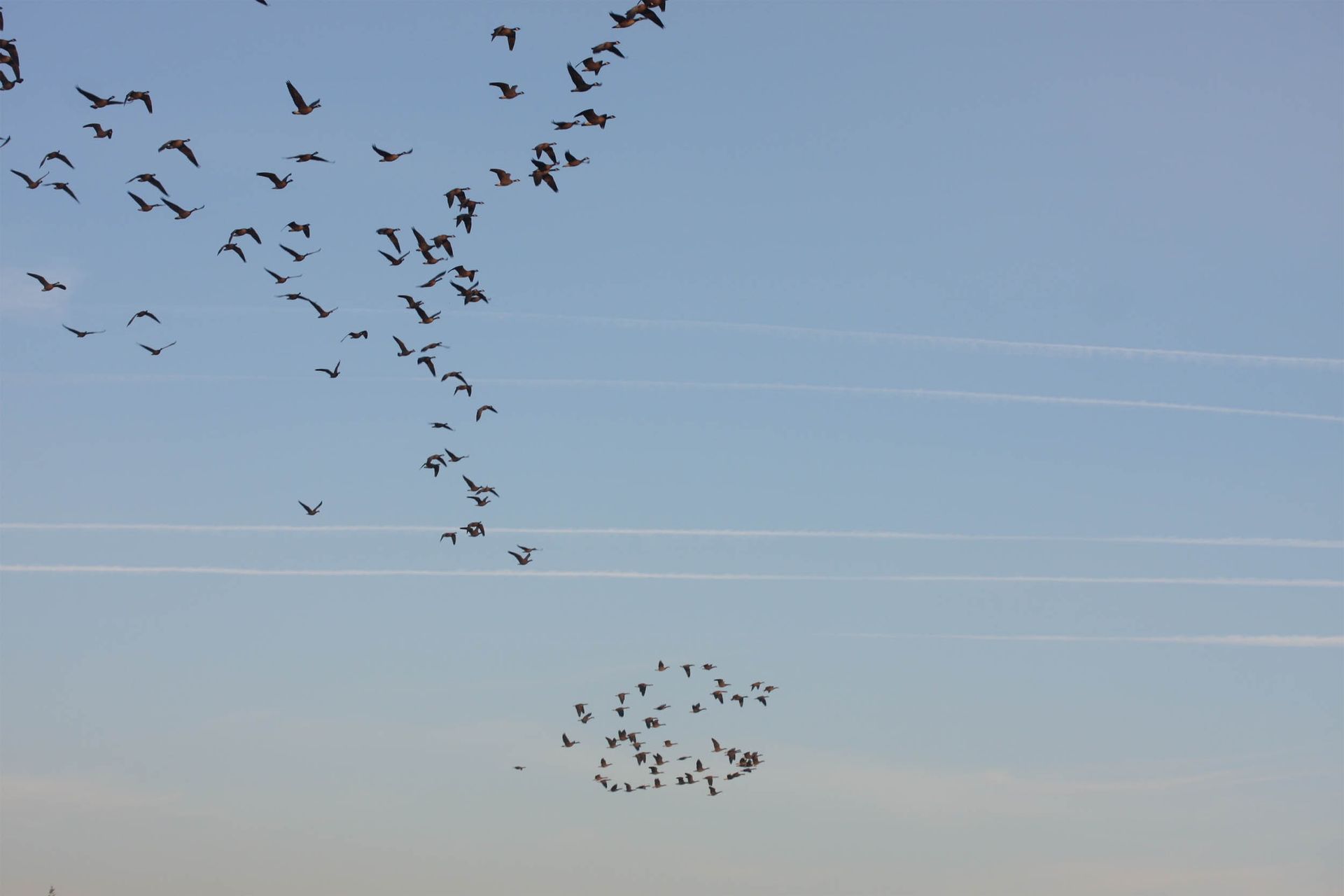
A hallmark of fall, seasonal migration is like a comfortable sweater or a good watch – it can be counted on. Its reliability and familiarity make the abnormal more acceptable. Whether sailing over oceans of smoke to the next green valley, or across highways, housing developments, and dry lakebeds, migration is increasingly abnormal for birds, but it has always been hard. So, why migrate? Why do these millions of animals fly, sometimes for thousands of miles, each season? It seems almost silly to suggest that it is for the warmer weather and the all-you-can-eat buffet, as though human snowbirds and actual snowbirds were the same. For birds, the act is not for luxury or mere comfort. It is a better shot at survival. And in this way, migration brings into focus the gulf between the near field and the long view, the proximate and ultimate causes operating on different scales. For example, the migration decisions a bird makes on a cold morning might seem to be about right now: Do I feel fat enough to fly far? Do I wait for a clear night to leave? Do I flock with a bunch of other birds like me? Should I land in those trees? Over time, these small, immediate decisions become consolidated into behaviors that are the grist of evolution and specific to each species.

Likewise, humans make decisions that are built up into longer stories that take years to tell. We like to make decisions that we can appreciate in each new slice of now, but we need a way to balance the decisions we make right now (to get a dog, to live in the woods, to thin a stand) with what these decisions will mean for us over time. We can calculate from things we’ve done or learned before, and anticipate what might be, to help us in the long view.

This anticipation of what might be does as much for the short-term and long-term survival of humans as knowing when to migrate, and where to stop, has mattered to populations and species of birds. However, we have more agency than birds do in how we respond to the anticipation of what might be. We can plan to shape our woodlands and yards in ways that balance multiple benefits. We can make immediate choices that support watersheds, migrating and breeding birds, and objectives of fire resilience, harvests, and planting for a new climate. There is a sweet spot between research, legacy, practical considerations, and collaboration that will allow us all to weather the unexpected, and the unwelcome expected, better together. We can plan ways to use lands in times and ways that minimize harm, maximize benefit to forests and birds, and make the places that we live and the job of stewarding the land a more optimistic and enjoyable job in the moment. Forestry for the Birds in the Pacific Northwest is that comfortable sweater you are looking for right now, but it is also there to help make a workable place for humans and birds for years to come.

When a lot seems to change in a short amount of time, we look to the metaphoric horizon to steady ourselves. Things like the return of green leaves to a winter landscape, the return of flowers, the hum of bees, and animal migration. Yet even migration – this example of timelessness of seasons and the resilience of life in the face of storms and fires and habitat loss – happens later, almost two weeks later for most species, than it did 50 years ago. While it may seem unsettling that even these timeless processes are fluid, it is also encouraging that change, too, is clocklike and reliable, like succession and seasonal renewal. We adjust. Burnscapes heal and forests come back. When the world shifts, we need to shift with it, and make sensible decisions with an eye toward the next harvest, the next copse of trees, the next spring, until we have a plan that makes sense for next year and for the long haul.

This year has been a difficult one with the return of devastating wildfires to the West. Places that haven’t burned in recent memory are burning. The past 20 years have seen more fires and more acres burned than in the previous 100. I think, as hard as this year has been, we are presented with a chance to reconsider our future, and draw on the best blend of science, economics, tradition, and anticipation to think about how silvicultural practices and conservation objectives in a given place can align to lay the groundwork for the next resilient, diverse, and productive forest. Together with the skulking robins, we’ll spend the winter constructing a road map for the space between the near and far field, a patch of shrubs heavy with berries, and a choice among several sweaters.

This preparation is comforting, the constancy of migration, succession, and seasonal renewal is comforting, even if decisions in the short term are hard. Rapid, dramatic changes such as wildfires demand more of our flexibility, and more attentiveness from our present decision-making to ensure that we’ll be better off in the long haul.

Recent Posts

By Aidan Juhl April 16, 2026
Written by Colleen Robinson
April 14, 2026
Written by Shannon Maes
April 14, 2026
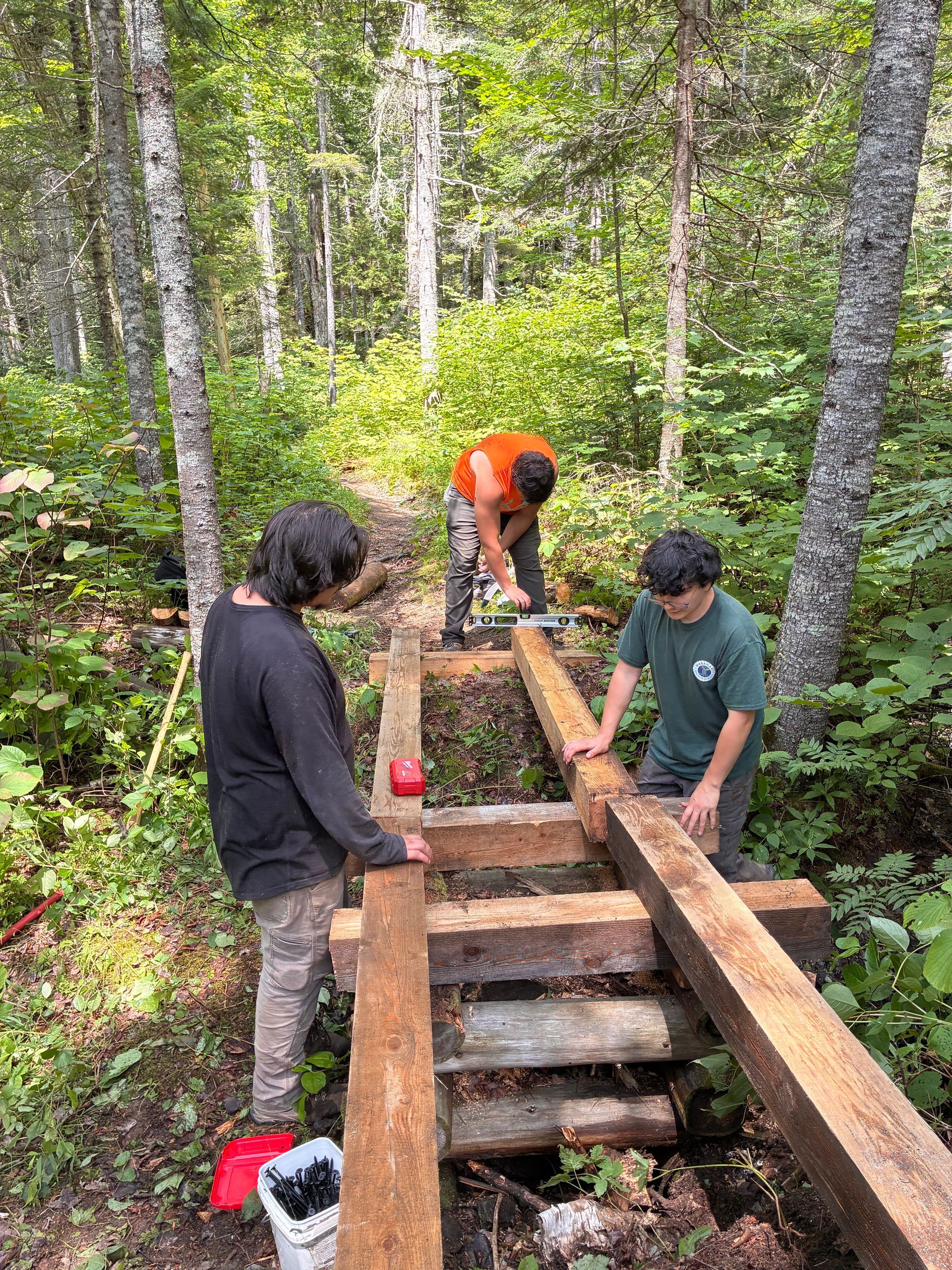
In September 2025, the Guild launched a three-person Forest Stewards Apprenticeship (FSA) crew to work with the Penobscot Nation’s Department of Natural Resources (PN DNR). Over the course of their six-month season, apprentices Agenor Duhon, Gabe Stewart, and Jacob Baker shared a season of learning, collaboration, and hands-on stewardship of Penobscot Tribal lands.
April 14, 2026
This week, I stepped into the role of crew leader. We worked a full 40-hour week, splitting our time between Clifton Farms and a prescribed burn operation. On the first day in the field, we completed hack-and-squirt treatments on trees that had been marked the previous week. For the remainder of the week, we focused on marking trees for future hack-and-squirt work, maintaining a steady pace and ensuring accuracy in our selections.
April 7, 2026
As Guild members, our practice is fundamentally grounded in field observation. We know intuitively that forests are dynamic, living communities. Yet, for decades, the high-level systems used to value our work, specifically the carbon accounting ledgers tied to international frameworks like the Paris Agreement, have treated forests as static, quantifiable blocks of land. In a recent commentary published in One Earth, I argue that these legacy measurement, reporting, and verification (MRV) frameworks are failing. Ledger accounting relies on crude land-use delineations and outdated technology, effectively penalizing the natural, seasonal flux of the ecosystems we manage every day. By forcing landscapes into rigid “forest” versus “non-forest” binaries, such legacy systems miss the complex reality on the ground. But a major shift is underway.
March 18, 2026
Women have always been a part of forestry. Historically, women often helped guide family decisions about when to cut, which trees to save, and how best to steward their land for the next generation. Historical accounts from the Southern Appalachians describe women’s roles in decisions about timber harvesting and prioritizing long-term forest health. These often-uncredited contributions are even reflected in Aldo Leopold’s A Sand County Almanac (1949), in which describes his stewardship philosophy informed not only by his professional experience, but by shared responsibility, where the perspectives of his wife and daughters played an important role.
March 18, 2026
Although rural regions often host the highest concentrations of public and private forest land, they typically lack the sustainable workforce necessary for active management and stewardship. How do we address this foundational problem in forest conservation?
March 18, 2026
The Forest Stewards Guild has a unique dual mandate: practice and promote forest stewardship. Personally, I think the combination of practicing forest management and promoting best practices is what makes the Guild a vibrant and impactful organization.
February 17, 2026
We celebrate the remarkable career and legacy of Leslie (Les) Benedict, who has provided visionary leadership and dedicated service to the stewardship of forests, championing the preservation of the ecological and culturally important black ash. Benedict, a member of the Saint Regis Mohawk Tribe in Akwesasne, north of the Adirondacks in upstate New York, recently retired after serving as the Assistant Director of the Tribe’s Environment Division for over 35 years.
February 17, 2026
The Forest Stewards Guild has been working to support the National Park Service on forest stewardship projects throughout the eastern U.S. This month we are in the midst of a project to protect mounds at Effigy Mounds National Monument near Harpers Ferry Iowa. This site was designated as a National Monument in 1949 and preserves over 200 mounds built between 800 and 2,500 years ago. Mounds at this site include conical, linear, compound, and effigy mounds – constructed in the shape of animals. Please see the National Park Service page for more information about the mounds, the people who built them, and how to visit the site. The lidar images on that website of the Marching Bears and other mound groups are fascinating.
Show More