A Champion of Black Ash and the Forest Community: Celebrating the Career and Legacy of Les Benedict  - Forest Stewards Guild

February 17, 2026

Written by Rachel Swanwick, Amanda Farris, Tyler Everett, Dr. Tony D’Amato 

Benedict co-authored the “Handbook for Black Ash Preservation, Reforestation, and Regeneration” in 2000 with Richard David, a foundational work on black ash taxonomy, seed collection, propagation, and out-planting. This handbook was truly visionary in developing and sharing the knowledge necessary to sustain black ash for future generations. It has become a central resource in guiding contemporary seed collection and reforestation strategies for preserving black ash across Tribal Nations and resource management agencies.  

Benedict also understood that to catalyze meaningful action in the realm of ash preservation, his teachings could not be confined to written literature. Working alongside David, he brought these teachings directly to Tribal Nation communities across the range of black ash. Together, they shared their knowledge in black ash seed collection and propagation protocols through hands-on, experiential learning. This approach not only equipped Tribal Nations with the skills to carry out this work independently, but also fostered a strong, enduring community of practice dedicated to protecting black ash. One story from Bendict and David’s travels recounts, 

“While out moving from one Tribal Nation or First Nation community to another sharing seed collection knowledge, they made the most of their time by collecting seed all along the way. This had them staying in hotels and motels across the range of black ash. One night they made it into their room late after a strenuous day of seed collection in black ash wetlands. They threw their seed down in the room and quickly fell asleep. In the morning it was not just the two of them in the room, they had been joined by hundreds of insects that emerged from the collected seed and clung to the ceiling of their motel room!”

Alongside their adventures, the ash preservation community has continued to grow, strengthened by a rising sense of urgency to protect black ash as emerald ash borer advances across its range. This early work in building a strong, connected foundation has directly inspired the development of a Tribal-led research agenda through the Ash Protection Collaboration Across Waponahkik (APCAW) at the University of Maine in Orono. Led by Benedict’s close friend and colleague, Dr. John Daigle (Penobscot Nation), this lab group has worked closely with Benedict to carry his work forward and support new generations of dedicated researchers and forest caretakers who continue the hands-on, experiential approach to ash preservation that Benedict and David first brought to this community. PhD Candidate and APCAW lab member Tyler Everett shares,

As a young indigenous scholar getting into the field of forestry and working in the arena of black ash preservation. I quickly became familiar with Les and the great work that he’s done. It made meeting him in person kind of daunting. But, with every interaction I’ve had with Les I’ve felt so invited in this space. He has a way of listening that strips away any imposter syndrome symptoms someone might have, and makes their contributions, however small, feel impactful and meaningful.”  

Through the years, Benedict has tirelessly given his time, energy, and wisdom to support black ash conservation through partnership with students, Tribal Nations, government agencies, universities, and non-profit organizations across the region. In 2022, he received a Certificate of Appreciation from the USDA Forest Service Eastern Region for his longstanding collaborative forest health work. In 2023, he co-authored companion articles in the Journal of Forestry that helped advance multi-stakeholder approaches to ash preservation and identify preservation values to guide stewardship. Benedict is also an active partner in the Guild’s Sustaining Ash Partners Network, and his contributions have helped foster collaboration to elevate the cultural significance of ash. Dr. Tony D’Amato, one of the many professionals who has benefited from Benedict’s leadership writes, 

“Les is an amazing teacher who is always willing to share his wisdom and perspective with anyone who cares about forests and their stewardship. I feel privileged to have been able to learn from Les and look at the forest and my role in its stewardship so differently thanks to his teachings. Our forest community has been so lucky to have such a giving and selfless mentor, teacher, and steward.”  

Like tree roots stretching in all directions, the people Benedict influenced have carried his stories forward, and the community sustaining black ash has grown stronger. In his retirement and between hunting and fishing trips, he plans to more deeply study the Mohawk language and continue to collaborate with partners like the Haudensaunee Environmental Task Force and the Abenaki Fist Nations Peoples in Odanak and WÔlinak on ash preservation. Benedict says that black ash brings us all together. By reaching so many people, his lifetime legacy of building community around black ash stands as a beacon of hope for future generations to carry forward a shared passion for preserving ash.  

References:  

  1. Benedict, L. & David, R. (2000). Handbook for Black Ash Preservation, Reforestation/regeneration. Mohawk Council of Akwesasne, Department of Environment.  
  2. USDA Forest Service. (2022, April 27). Tribal partner recognized for lengthy support of forest health projects. U.S. Department of Agriculture. https://www.fs.usda.gov/inside-fs/recognition/tribal-partner-recognized-lengthy-support-forest-health-projects  
  3. Anthony W D’Amato, David A Orwig, Nathan W Siegert, Amanda Mahaffey, Les Benedict, Tyler Everett, John Daigle, Logan Johnson, Paul Catanzaro, Caitlin Cusack, Towards Tree Species Preservation: Protecting Ash Amidst the Emerald Ash Borer Invasion in the Northeast, Journal of Forestry, Volume 121, Issue 5-6, September/November 2023, Pages 480–487, https://doi.org/10.1093/jofore/fvad025  
  4. Anthony W D’Amato, David A Orwig, Nathan W Siegert, Amanda Mahaffey, Les Benedict, Tyler Everett, John Daigle, Logan Johnson, Paul Catanzaro, Caitlin Cusack, Species Preservation in the Face of Novel Threats: Cultural, Ecological, and Operational Considerations for Preserving Tree Species in the Context of Non-Indigenous Insects and Pathogens, Journal of Forestry, Volume 121, Issue 5-6, September/November 2023, Pages 470–479, https://doi.org/10.1093/jofore/fvad024

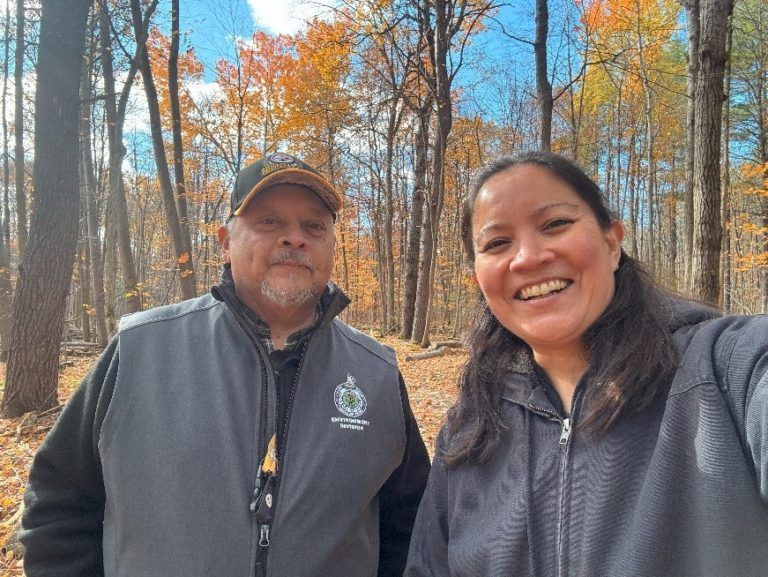
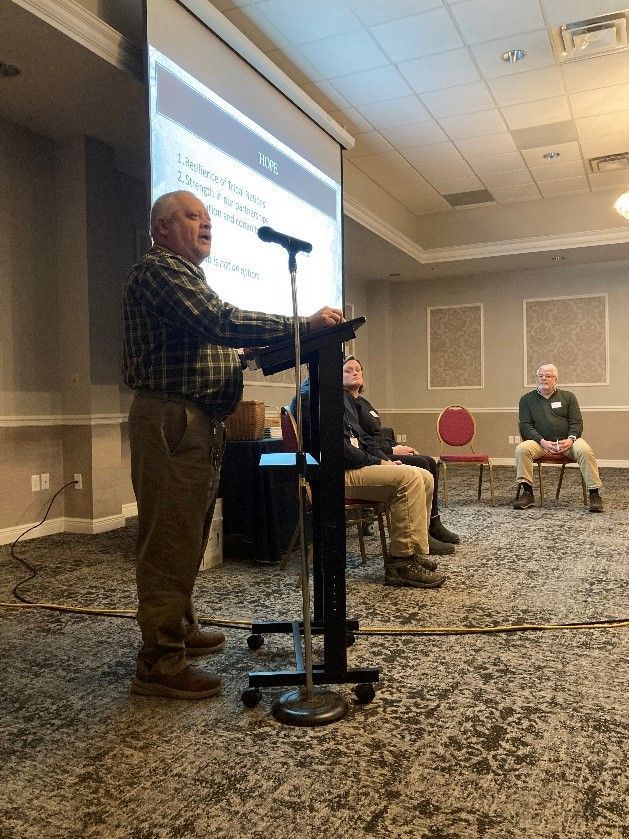
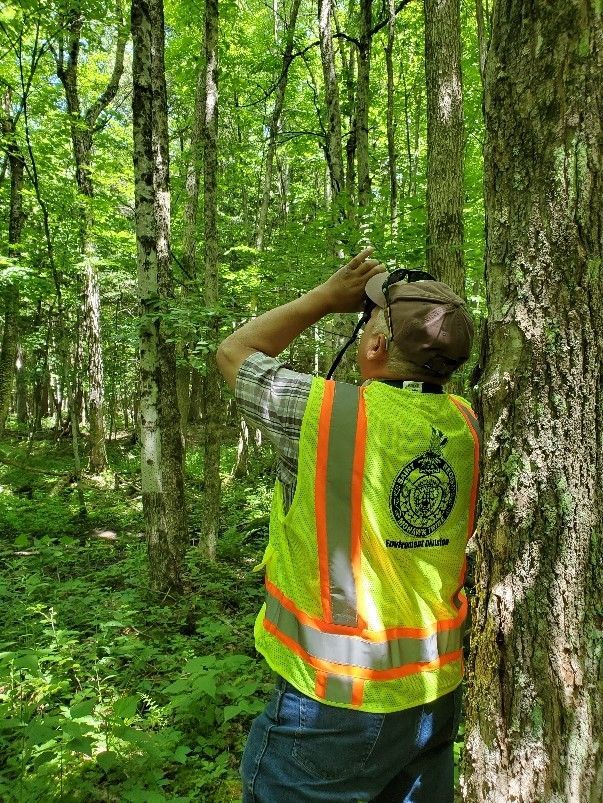
We celebrate the remarkable career and legacy of Leslie (Les) Benedict, who has provided visionary leadership and dedicated service to the stewardship of forests, championing the preservation of the ecological and culturally important black ash. Benedict, a member of the Saint Regis Mohawk Tribe in Akwesasne, north of the Adirondacks in upstate New York, recently retired after serving as the Assistant Director of the Tribe’s Environment Division for over 35 years.  

His work with black ash began in 1991 through the Akwesasne Task Force on the Environment, in response to community concerns about the health and future of black ash. This work was pivotal in building an understanding of the silvics of this species, whose survival, just years later, was proven functionally threatened by the emerald ash borer, an introduced forest pest. Black ash is an important cultural material, most notably used for crafting baskets as an art form and for use in ceremonies, trade, traps, and storage1. As Benedict shared, basket making “is a cultural practice that is part of our cultural identity” that has been passed down through Indigenous communities for thousands of years.  

Recent Posts

By Aidan Juhl April 16, 2026
Written by Colleen Robinson
April 14, 2026
Written by Shannon Maes
April 14, 2026
In September 2025, the Guild launched a three-person Forest Stewards Apprenticeship (FSA) crew to work with the Penobscot Nation’s Department of Natural Resources (PN DNR). Over the course of their six-month season, apprentices Agenor Duhon, Gabe Stewart, and Jacob Baker shared a season of learning, collaboration, and hands-on stewardship of Penobscot Tribal lands.
April 14, 2026
This week, I stepped into the role of crew leader. We worked a full 40-hour week, splitting our time between Clifton Farms and a prescribed burn operation. On the first day in the field, we completed hack-and-squirt treatments on trees that had been marked the previous week. For the remainder of the week, we focused on marking trees for future hack-and-squirt work, maintaining a steady pace and ensuring accuracy in our selections.
April 7, 2026
As Guild members, our practice is fundamentally grounded in field observation. We know intuitively that forests are dynamic, living communities. Yet, for decades, the high-level systems used to value our work, specifically the carbon accounting ledgers tied to international frameworks like the Paris Agreement, have treated forests as static, quantifiable blocks of land. In a recent commentary published in One Earth, I argue that these legacy measurement, reporting, and verification (MRV) frameworks are failing. Ledger accounting relies on crude land-use delineations and outdated technology, effectively penalizing the natural, seasonal flux of the ecosystems we manage every day. By forcing landscapes into rigid “forest” versus “non-forest” binaries, such legacy systems miss the complex reality on the ground. But a major shift is underway.
March 18, 2026
Women have always been a part of forestry. Historically, women often helped guide family decisions about when to cut, which trees to save, and how best to steward their land for the next generation. Historical accounts from the Southern Appalachians describe women’s roles in decisions about timber harvesting and prioritizing long-term forest health. These often-uncredited contributions are even reflected in Aldo Leopold’s A Sand County Almanac (1949), in which describes his stewardship philosophy informed not only by his professional experience, but by shared responsibility, where the perspectives of his wife and daughters played an important role.
March 18, 2026
Although rural regions often host the highest concentrations of public and private forest land, they typically lack the sustainable workforce necessary for active management and stewardship. How do we address this foundational problem in forest conservation?
March 18, 2026
The Forest Stewards Guild has a unique dual mandate: practice and promote forest stewardship. Personally, I think the combination of practicing forest management and promoting best practices is what makes the Guild a vibrant and impactful organization.
February 17, 2026
The Forest Stewards Guild has been working to support the National Park Service on forest stewardship projects throughout the eastern U.S. This month we are in the midst of a project to protect mounds at Effigy Mounds National Monument near Harpers Ferry Iowa. This site was designated as a National Monument in 1949 and preserves over 200 mounds built between 800 and 2,500 years ago. Mounds at this site include conical, linear, compound, and effigy mounds – constructed in the shape of animals. Please see the National Park Service page for more information about the mounds, the people who built them, and how to visit the site. The lidar images on that website of the Marching Bears and other mound groups are fascinating.
February 17, 2026
Climate change will impact different forest ecosystems in varying ways, and management strategies to adapt forests to these risks varies across ecosystem conditions, management goals, and desired future conditions specific to the target location. The Adaptive Silviculture for Climate Change (ASCC) Network was established in 2009 in response to this need for localized, operational examples of climate adaptation in different ecosystem contexts. The Network is a collaborative effort to establish a series of experimental silvicultural trials across different forest ecosystems, aiming to provide managers with examples of how to integrate climate adaptation into their silvicultural planning and management actions.
Show More