Wildfires and the US Forest Service

May 14, 2026

Written by Zander Evans

Forests have been in the media more than usual because of worries about the upcoming fire season and changes at the US Forest Service (USFS). Even Guild members working on private lands, far from the highest wildfire risk, can be directly affected by these national issues. 


The summer is setting up to be a rough wildfire season because of the lack of snow (see the current seasonal outlook). Over 50,000 acres have already burned in Georgia, and wildfires are starting to ignite across the west (e.g., a recent start near Sisters, OR). Staff reductions at the US Forest Service (USFS) have prompted concerns about both the crucial pre-fire mitigation and wildfire response. NPR reports that USFS’s conducted fuel reduction work on 1.5 million fewer acres less in 2025 than in 2024. However, USFS Chief Tom Schultz says the agency is ready “Our firefighters are prepared, our agencies are coordinated, and we will continue doing everything we can to protect communities and the people who defend them.” We can all help by avoiding unwanted human-caused wildfires. 


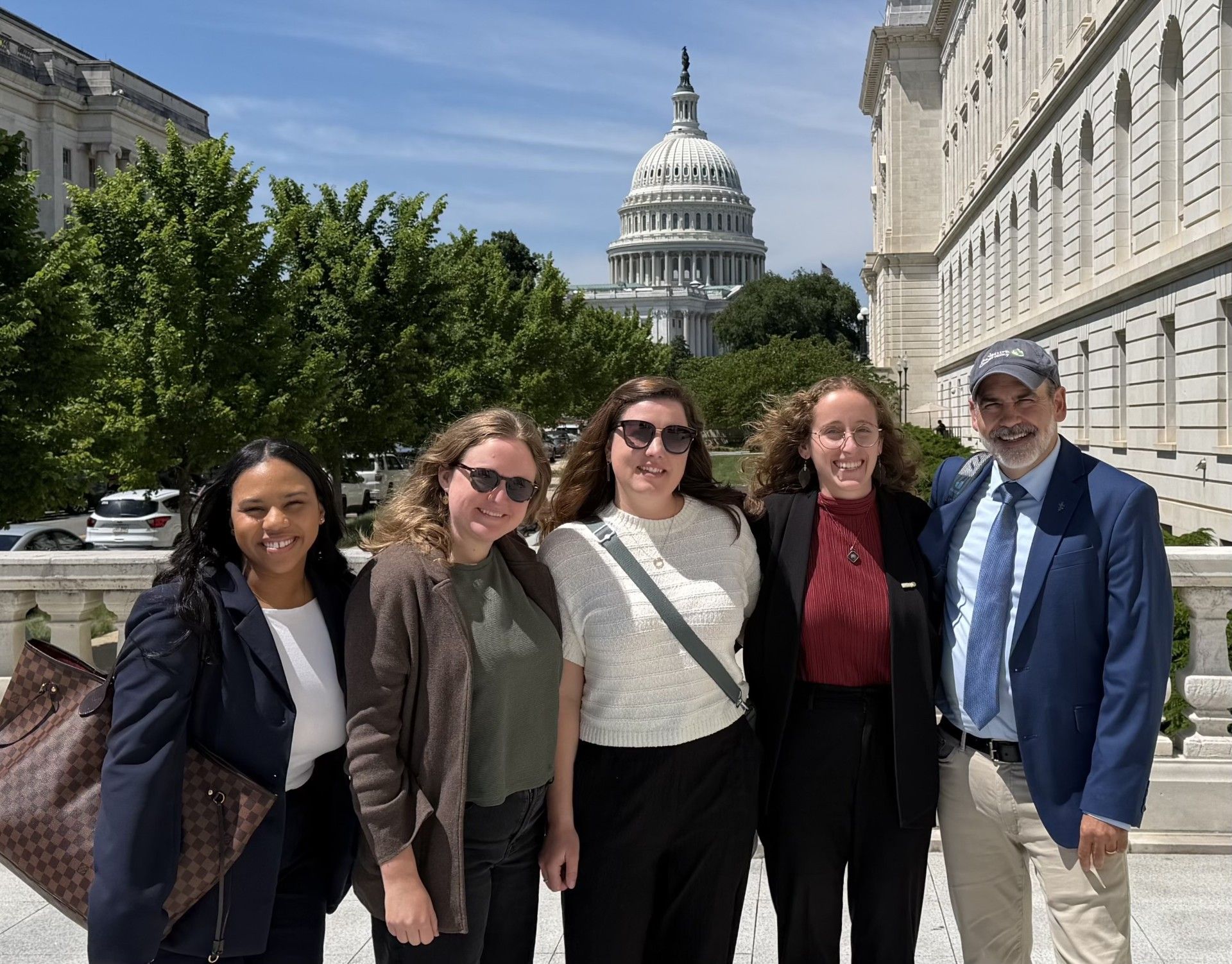
The Guild recognizes that beneficial fire is crucial for long-term safety of communities and the health of fire adapted forests (see the Policy Statement on Fire, Forest Management, and Communities). That said, hot and dry conditions mean much of this work will have to wait until this fall (though local conditions are permitting safe, effective prescribed fire in some locations). This week the Guild’s fire policy expert, Esmé Cadiente, joined partners in Washington, DC, to help educate lawmakers and their staff about the importance of beneficial fire for long-term wildfire resilience. The Guild’s nonpartisan, experience-based insights help connect policy makers to the realities of working in the woods.  
US Forest Service 

The USFS is also in the news because of their reorganization. Because a reorganization of this magnitude will leave some folks dislocated and adrift, the Guild is inviting USFS staff or former staff to join the Guild for free through June 2027. 


The Guild is also carefully tracking what the reorganization means for land management, research, and all the other crucial functions the USFS provides. In these polarized political times, it can be hard to separate facts from rumors, so the agency’s website is useful: https://www.fs.usda.gov/about-agency/reorganization. Still, there is confusion between the administration’s broader goals and the agency’s vision. For example, Deputy Chief French has emphasized USFS will preserve research, while the President's 2027 budget proposes eliminating USFS research funding entirely. 


Another source of confusion is the proposal to move wildland fire activities out of the USFS and into the new Wildland Fire Service (WFS). Consolidation of wildfire management is already underway within DOI. While consolidation of all firefighting into the WFS could be beneficial to forest management, there is significant concern that the move could be detrimental to both fire and forest management. For example, the National Association of Forest Service Retirees point to the risk of separating fire management from land stewardship. USDA is contracting a Feasibility Study on Consolidating Wildland Fire Management Operations which should provide objective, evidence-based analysis this fall.  


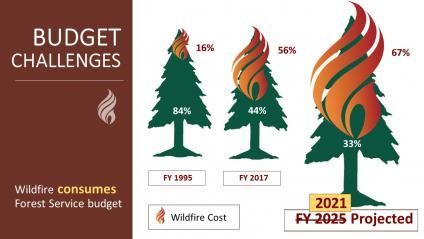
Another important issue on the horizon is the expiration of the bipartisan Wildfire Funding Fix. Nearly ten years ago, a broad coalition of organizations and leaders from across the political spectrum, including the Guild, came together to address the growth of wildfire expenses. If the Wildfire Funding Fix expires, the USFS will be forced to take funds from wildfire prevention, fuels mitigation, timber management, wildlife habitat, and recreational programs to cover the costs of fire suppression.  


All the uncertainty around federal fire and forest management is worrying – especially at a time when fire seasons are becoming longer, more complex, and more expensive. Effective wildfire response depends not only on firefighters, but also on the broader land management workforce—including hydrologists, biologists, planners, and other specialists who support incident management teams and post-fire recovery efforts. At the same time, wildfire suppression costs continue to strain federal and state budgets, often at the expense of investments in proactive forest restoration, beneficial fire, and community preparedness. The Guild believes durable solutions require sustained investment in both wildfire response capacity and the long-term stewardship work that helps reduce wildfire risk in the first place. This includes maintaining strong partnerships across federal, Tribal, state, local, nonprofit, and private organizations to ensure forests and communities are better prepared for the challenges ahead. 


Recent Posts

By Daisy Smith May 14, 2026
Written by Zander Evans
May 14, 2026
A science inspired art show in Taos, NM Written by Cody Dems
By Aidan Juhl April 16, 2026
Written by Colleen Robinson
April 14, 2026
Written by Shannon Maes
April 14, 2026
In September 2025, the Guild launched a three-person Forest Stewards Apprenticeship (FSA) crew to work with the Penobscot Nation’s Department of Natural Resources (PN DNR). Over the course of their six-month season, apprentices Agenor Duhon, Gabe Stewart, and Jacob Baker shared a season of learning, collaboration, and hands-on stewardship of Penobscot Tribal lands.
April 14, 2026
This week, I stepped into the role of crew leader. We worked a full 40-hour week, splitting our time between Clifton Farms and a prescribed burn operation. On the first day in the field, we completed hack-and-squirt treatments on trees that had been marked the previous week. For the remainder of the week, we focused on marking trees for future hack-and-squirt work, maintaining a steady pace and ensuring accuracy in our selections.
April 7, 2026
As Guild members, our practice is fundamentally grounded in field observation. We know intuitively that forests are dynamic, living communities. Yet, for decades, the high-level systems used to value our work, specifically the carbon accounting ledgers tied to international frameworks like the Paris Agreement, have treated forests as static, quantifiable blocks of land. In a recent commentary published in One Earth, I argue that these legacy measurement, reporting, and verification (MRV) frameworks are failing. Ledger accounting relies on crude land-use delineations and outdated technology, effectively penalizing the natural, seasonal flux of the ecosystems we manage every day. By forcing landscapes into rigid “forest” versus “non-forest” binaries, such legacy systems miss the complex reality on the ground. But a major shift is underway.
March 18, 2026
Women have always been a part of forestry. Historically, women often helped guide family decisions about when to cut, which trees to save, and how best to steward their land for the next generation. Historical accounts from the Southern Appalachians describe women’s roles in decisions about timber harvesting and prioritizing long-term forest health. These often-uncredited contributions are even reflected in Aldo Leopold’s A Sand County Almanac (1949), in which describes his stewardship philosophy informed not only by his professional experience, but by shared responsibility, where the perspectives of his wife and daughters played an important role.
March 18, 2026
Although rural regions often host the highest concentrations of public and private forest land, they typically lack the sustainable workforce necessary for active management and stewardship. How do we address this foundational problem in forest conservation?
March 18, 2026
The Forest Stewards Guild has a unique dual mandate: practice and promote forest stewardship. Personally, I think the combination of practicing forest management and promoting best practices is what makes the Guild a vibrant and impactful organization.
Show More