New Mexico’s Final Collaborative Forest Restoration Project Comes to an End

October 15, 2025

Written by Rachel Bean with excerpts from La Jicarita’s “Rio de Las Trampas Forest Council Wraps up Project: What’s Next?” by Kay Matthews 

Creation of the Collaborative Forest Restoration Project Program 

In 2000, Congress passed the Community Forest Restoration Act to address conflicts over forest management after years of fire suppression and logging. This led to the creation of the Collaborative Forest Restoration Program (CFRP) in New Mexico and provided federal funds through the U.S. Forest Service (USFS) for collaborative science-based restoration projects to improve forest health and watershed conditions. This program provides a framework for community groups to collaborate and propose restoration projects on public or tribal forested land. Overarching program goals included wildfire threat reduction; ecosystem restoration, including non-native species reduction; reestablishment of historic fire regimes; reforestation; preservation of old and large trees; small diameter tree utilization; creation of forest-related local employment; and stakeholder diversity. 

The nature of CFRP funding led to many innovative projects in forest types and communities which had not previously seen this type of ecologically based restoration, and the requirement for collaboration brought together environmental groups, community members, NGOs, and federal and state governments and agencies under a shared goal. In this way, the program jumpstarted the movement toward collaborative forestry which has continued to gain momentum through current day with the advent of the larger-scale multi-decadal Collaborative Forest and Landscape Restoration Program (CFLRP) and USFS Priority Landscapes. These and similar programs prioritize funding for collaborative forest, watershed, and grassland restoration projects across fencelines and jurisdictions (at a landscape scale) to reduce wildfire risk and improve ecosystem health. While there was some variation in CFRP projects’ efficacy in meeting these goals in different ecotypes and various treatments, it is generally considered a successful program. “Since 2001… the Collaborative Forest Restoration Program has made at least part-time allies of former foes in New Mexico’s environmental wars”(CaseBriefing_NM-CFRP). 

Community Forest Stewardship in Rural New Mexico 

The final round of CFRP projects were selected in 2019 and awarded in 2021 (a delay caused by the global Coronavirus pandemic). The last active award – for which the Forest Stewards Guild was the funding recipient – wrapped up in early September 2025, sunsetting the program after nearly two and a half decades. The Rio de Las Trampas Forest Restoration Project, seated in the western foothills of the Sangre de Cristo Mountains in northern New Mexico, began as a collaboration between the Forest Stewards Guild, Rio de Las Trampas Forest Council (run by a board of local community members), and the Camino Real Ranger District of Carson National Forest. It built on a local 1990s USFS Contract Stewardship program and subsequent 2018 pilot project which were intended to rebuild public trust in land management agencies and engage the community in Wildland-Urban Interface (WUI) forest restoration.

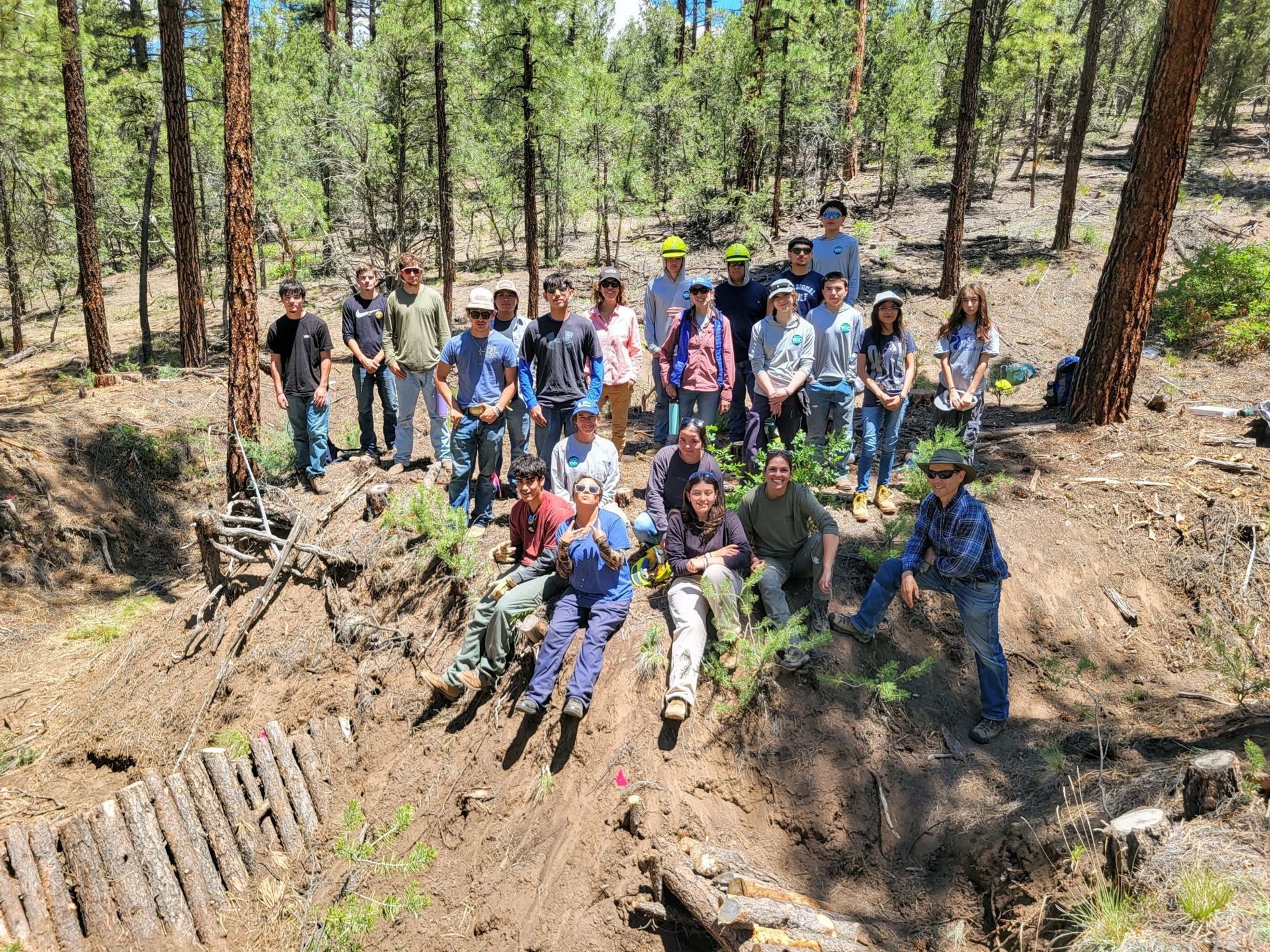
This restoration project recruited local leñeros, or woodcutters, to thin ponderosa pine and piñon-juniper forest on National Forest System lands, according to USFS silvicultural prescription standards for WUI fire risk reduction. Under this model, each leñero was assigned one acre to thin, remove larger diameter tree trunks and limbs, and lop and scatter the remaining slash to prepare the area for future prescribed burning. Upon completion of their acre, the leñeros were paid $300 and took home all the harvested wood for private firewood use or to sell. The entire project was overseen by Forest Mayordomo, or local leader, who decided which leñero would be assigned which acre, provided forest restoration training to the leñeros, and determined when an acre was thinned satisfactorily. These roles and titles correlate directly to local systems of governance which are common in these traditional communities (https://searchlightnm.org/water-is-life/). 

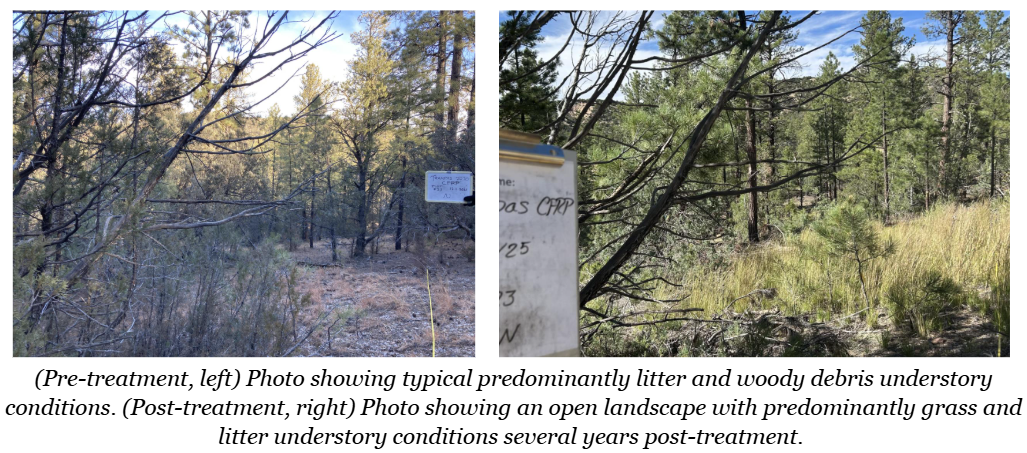
Over the life of the project, local leñeros were trained in Forest Worker Safety and First Aid, completed their cutting units and received payment, and supplied over 200 cords of wood to community members; three watershed protection and erosion control educational workshops were held in the project area; local youth were engaged through job fairs, ecological monitoring, and watershed restoration activities; and the silvicultural prescription goals were largely met with tree stand density decreasing 76% (from 284 to 68 trees per acre) and average canopy cover decreasing from 58% to 27% post-treatment. This leaves more of the forest floor exposed to sunlight and snowfall, potentially helping to bolster understory vegetation growth and aquifer recharge. An observed increase in average height from the ground surface to the lower canopy (lowest live branches on the trees) will also help prevent crown fires. As they thinned, leñeros focused on cutting small diameter, overcrowded, unhealthy trees. 

Future of Community Forestry 

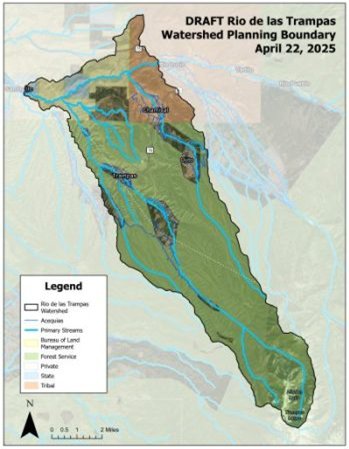
A particularly positive outcome of this CFRP and the larger community forestry initiative is the impending implementation of another large-scale community-based management program. The Rio de Las Trampas Watershed Plan and implementation work are collaborative projects that address various land-based management concerns within the Rio de las Trampas watershed: forest restoration prescription design, erosion control/soil health projects, slash management, access to fuelwood and other wood products, maintenance of recreation infrastructure, and long-term monitoring. Key partners include the Forest Stewards Guild, Rio de Las Trampas Forest Council, USFS – Camino Real Ranger District, Taos County, and Taos Soil and Water Conservation District. This continuation of community forestry on public and private lands will build on the groundwork laid over the past 30 years, incorporating best available science for mesic forest restoration as well as community priorities and input. J.R. Logan, Taos County Forest and Watershed Health Program Manager, says “this is our opportunity to get creative, and to design project work that balances the needs and desires of community members as much as possible… It’s on our backs now, not the green [Forest Service].”

The Guild is honored to play a key facilitation role in this effort. Convening dedicated partners who each have unique and invaluable contributions in collaborative work across the U.S, is one way we support inspiring efforts toward our collective vision!

Recent Posts

By Aidan Juhl April 16, 2026
Written by Colleen Robinson
April 14, 2026
Written by Shannon Maes
April 14, 2026
In September 2025, the Guild launched a three-person Forest Stewards Apprenticeship (FSA) crew to work with the Penobscot Nation’s Department of Natural Resources (PN DNR). Over the course of their six-month season, apprentices Agenor Duhon, Gabe Stewart, and Jacob Baker shared a season of learning, collaboration, and hands-on stewardship of Penobscot Tribal lands.
April 14, 2026
This week, I stepped into the role of crew leader. We worked a full 40-hour week, splitting our time between Clifton Farms and a prescribed burn operation. On the first day in the field, we completed hack-and-squirt treatments on trees that had been marked the previous week. For the remainder of the week, we focused on marking trees for future hack-and-squirt work, maintaining a steady pace and ensuring accuracy in our selections.
April 7, 2026
As Guild members, our practice is fundamentally grounded in field observation. We know intuitively that forests are dynamic, living communities. Yet, for decades, the high-level systems used to value our work, specifically the carbon accounting ledgers tied to international frameworks like the Paris Agreement, have treated forests as static, quantifiable blocks of land. In a recent commentary published in One Earth, I argue that these legacy measurement, reporting, and verification (MRV) frameworks are failing. Ledger accounting relies on crude land-use delineations and outdated technology, effectively penalizing the natural, seasonal flux of the ecosystems we manage every day. By forcing landscapes into rigid “forest” versus “non-forest” binaries, such legacy systems miss the complex reality on the ground. But a major shift is underway.
March 18, 2026
Women have always been a part of forestry. Historically, women often helped guide family decisions about when to cut, which trees to save, and how best to steward their land for the next generation. Historical accounts from the Southern Appalachians describe women’s roles in decisions about timber harvesting and prioritizing long-term forest health. These often-uncredited contributions are even reflected in Aldo Leopold’s A Sand County Almanac (1949), in which describes his stewardship philosophy informed not only by his professional experience, but by shared responsibility, where the perspectives of his wife and daughters played an important role.
March 18, 2026
Although rural regions often host the highest concentrations of public and private forest land, they typically lack the sustainable workforce necessary for active management and stewardship. How do we address this foundational problem in forest conservation?
March 18, 2026
The Forest Stewards Guild has a unique dual mandate: practice and promote forest stewardship. Personally, I think the combination of practicing forest management and promoting best practices is what makes the Guild a vibrant and impactful organization.
February 17, 2026
We celebrate the remarkable career and legacy of Leslie (Les) Benedict, who has provided visionary leadership and dedicated service to the stewardship of forests, championing the preservation of the ecological and culturally important black ash. Benedict, a member of the Saint Regis Mohawk Tribe in Akwesasne, north of the Adirondacks in upstate New York, recently retired after serving as the Assistant Director of the Tribe’s Environment Division for over 35 years.
February 17, 2026
The Forest Stewards Guild has been working to support the National Park Service on forest stewardship projects throughout the eastern U.S. This month we are in the midst of a project to protect mounds at Effigy Mounds National Monument near Harpers Ferry Iowa. This site was designated as a National Monument in 1949 and preserves over 200 mounds built between 800 and 2,500 years ago. Mounds at this site include conical, linear, compound, and effigy mounds – constructed in the shape of animals. Please see the National Park Service page for more information about the mounds, the people who built them, and how to visit the site. The lidar images on that website of the Marching Bears and other mound groups are fascinating.
Show More