Wetland Forest Conservation in Georgia

February 15, 2022

Written by Dakota Wagner

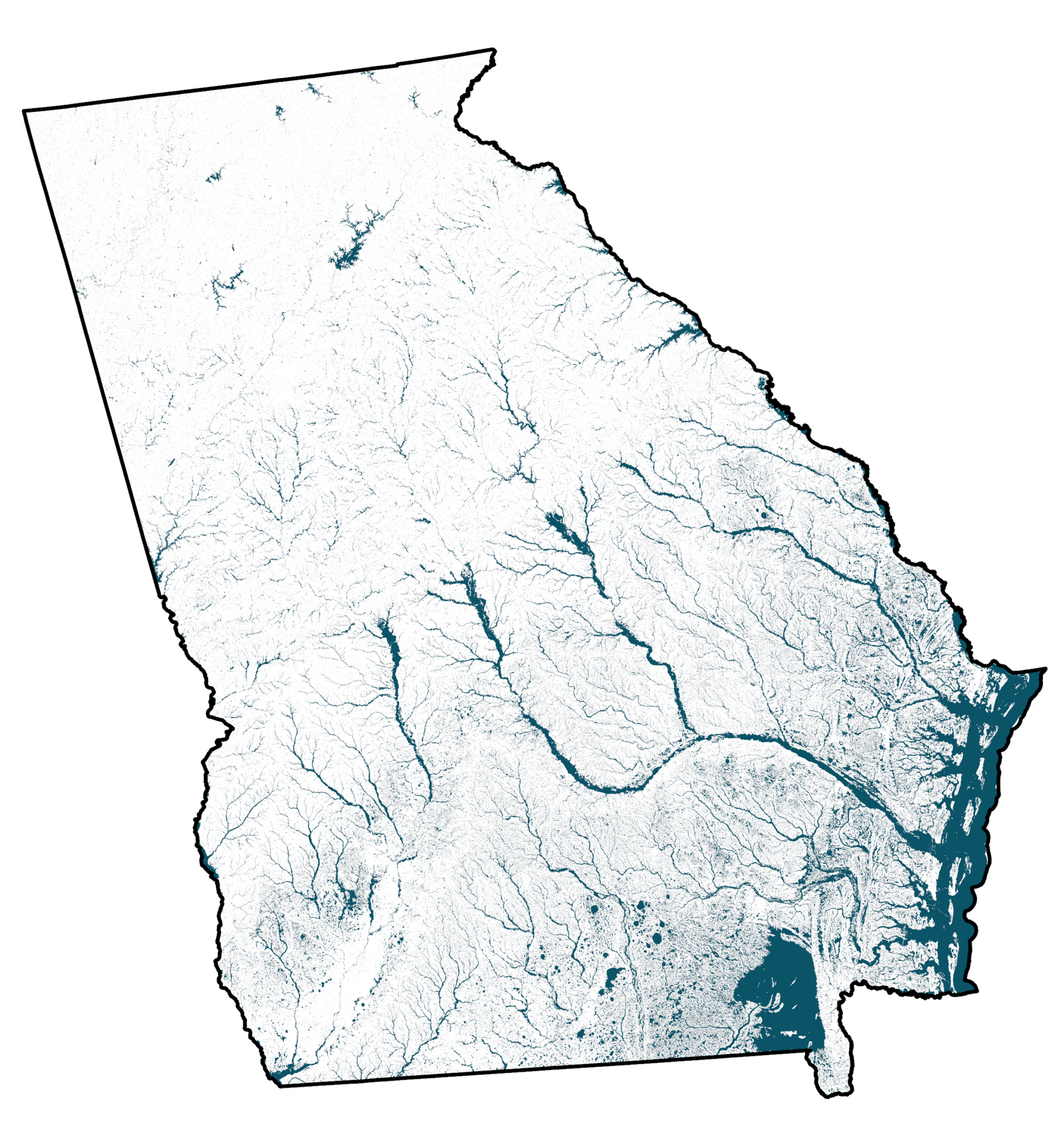
Wetland coverage data image for GA

At a Guild bottomland hardwoods workshop in Brunswick, Georgia in 2018 participants were asked: what are the limitations and barriers to wetland restoration and protection? Among others, answers included:

  • the lack of education, awareness, and guidance for private landowners,
  • the lack of wood product markets for many primary wetland tree species,
  • the lack of low impact harvesting equipment, and
  • the lack of a more comprehensive suite of conservation incentives aimed at wetland restoration.

Restoring Georgia’s wetlands has been a topic of great interest to that event’s cohost Gordon Rogers of Flint Riverkeeper for the last four decades. In 2019, a Sapelo Foundation grant provided an opportunity for the Guild to work with Flint Riverkeeper on an advocacy project focused on wetland restoration in Georgia.

We began our work with the vision to reverse the trend of wetlands loss and increase the acres of wetlands restored and conserved in Georgia’s forest landscapes. One primary goal was to build the foundation for a policy strategy to create a state-level incentive program for wetland forest conservation.

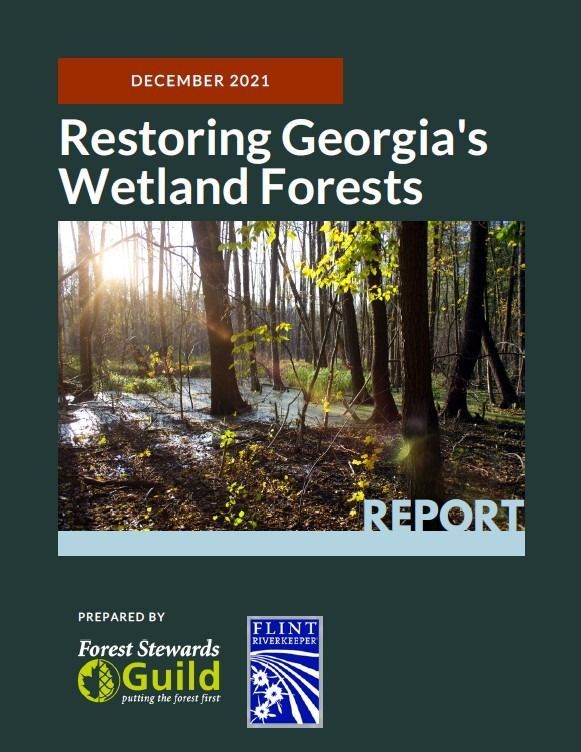
Cover image of the report: Restoring GA's Wetland Forests

After months of research, communicating with a diverse array of stakeholders, and weekly meetings, we are publishing the results of our findings. This report provides information about approaches to creating a viable program to incentivize wetlands conservation in Georgia. Our vision is to use our findings to influence key non-governmental players in Georgia to work with elected and appointed policymakers to develop a wetlands conservation incentives program that increases the acreage of functional wetlands in the state.

Report Snapshot
Wetlands in the state of Georgia cover approximately 18.4 percent of the state’s landscape. Unfortunately, historical and current wetland losses due to land conversion have negatively impacted these sites. As an alternative to government regulations, voluntary wetland restoration will be critical to the long-term conservation of wetland areas. Our report aims to provide information about how to strategically approach the creation of a viable program to incentivize wetland conservation on private lands in the state of Georgia. Based on research findings and stakeholder input, a basic recommended program outline was identified.

In summary, this program should be targeted towards private forest landowners and aim to restore degraded wetlands to proper hydrological function, create and incentivize appropriate wetland forest management activity parameters, and protect wetland resources through long-term conservation easements. Economic incentive programs can often be structured to achieve greater conservation goals than would result from traditional regulation. This program, whether started from square one or incorporated into an existing program, will build on current regional conservation partnerships to further increase the capacity of wetlands conservation.

Editor’s note: the feature image of this article provided by the US Fish and Wildlife Service.

Recent Posts

By Aidan Juhl April 16, 2026
Written by Colleen Robinson
April 14, 2026
Written by Shannon Maes
April 14, 2026
In September 2025, the Guild launched a three-person Forest Stewards Apprenticeship (FSA) crew to work with the Penobscot Nation’s Department of Natural Resources (PN DNR). Over the course of their six-month season, apprentices Agenor Duhon, Gabe Stewart, and Jacob Baker shared a season of learning, collaboration, and hands-on stewardship of Penobscot Tribal lands.
April 14, 2026
This week, I stepped into the role of crew leader. We worked a full 40-hour week, splitting our time between Clifton Farms and a prescribed burn operation. On the first day in the field, we completed hack-and-squirt treatments on trees that had been marked the previous week. For the remainder of the week, we focused on marking trees for future hack-and-squirt work, maintaining a steady pace and ensuring accuracy in our selections.
April 7, 2026
As Guild members, our practice is fundamentally grounded in field observation. We know intuitively that forests are dynamic, living communities. Yet, for decades, the high-level systems used to value our work, specifically the carbon accounting ledgers tied to international frameworks like the Paris Agreement, have treated forests as static, quantifiable blocks of land. In a recent commentary published in One Earth, I argue that these legacy measurement, reporting, and verification (MRV) frameworks are failing. Ledger accounting relies on crude land-use delineations and outdated technology, effectively penalizing the natural, seasonal flux of the ecosystems we manage every day. By forcing landscapes into rigid “forest” versus “non-forest” binaries, such legacy systems miss the complex reality on the ground. But a major shift is underway.
March 18, 2026
Women have always been a part of forestry. Historically, women often helped guide family decisions about when to cut, which trees to save, and how best to steward their land for the next generation. Historical accounts from the Southern Appalachians describe women’s roles in decisions about timber harvesting and prioritizing long-term forest health. These often-uncredited contributions are even reflected in Aldo Leopold’s A Sand County Almanac (1949), in which describes his stewardship philosophy informed not only by his professional experience, but by shared responsibility, where the perspectives of his wife and daughters played an important role.
March 18, 2026
Although rural regions often host the highest concentrations of public and private forest land, they typically lack the sustainable workforce necessary for active management and stewardship. How do we address this foundational problem in forest conservation?
March 18, 2026
The Forest Stewards Guild has a unique dual mandate: practice and promote forest stewardship. Personally, I think the combination of practicing forest management and promoting best practices is what makes the Guild a vibrant and impactful organization.
February 17, 2026
We celebrate the remarkable career and legacy of Leslie (Les) Benedict, who has provided visionary leadership and dedicated service to the stewardship of forests, championing the preservation of the ecological and culturally important black ash. Benedict, a member of the Saint Regis Mohawk Tribe in Akwesasne, north of the Adirondacks in upstate New York, recently retired after serving as the Assistant Director of the Tribe’s Environment Division for over 35 years.
February 17, 2026
The Forest Stewards Guild has been working to support the National Park Service on forest stewardship projects throughout the eastern U.S. This month we are in the midst of a project to protect mounds at Effigy Mounds National Monument near Harpers Ferry Iowa. This site was designated as a National Monument in 1949 and preserves over 200 mounds built between 800 and 2,500 years ago. Mounds at this site include conical, linear, compound, and effigy mounds – constructed in the shape of animals. Please see the National Park Service page for more information about the mounds, the people who built them, and how to visit the site. The lidar images on that website of the Marching Bears and other mound groups are fascinating.
Show More