Member insights building the Guild’s collective wisdom

October 14, 2021

Written by Colleen Robinson

Recently, we intentionally touched base with members through a Guild member survey. Thank you to everyone who shared thoughts, ideas, and offers to contribute. The survey responses are rich, informative, engaging, and we are so grateful. One of our Guild principals is about remaining humble. We want you to know that we hear you, we learn from you, and we all have an amazing community where we can keep asking our questions and making a difference. Collaboration and community remain strong in the Guild. A snapshot of the wealth of responses follows, and we hope you find it interesting and encouraging.

Our top goals for the survey were to: 

  1. Find out if what we offer and how we offer it to members is desirable and helpful.
  2. Explore what is missing, from our members’ perspectives, regarding the experience of membership in the Guild or the work the Guild does.
  3. Prioritize next steps with input from members on what is most important.
  4. Recruit support and assistance for getting more good work done collaboratively within this community, in win-win scenarios.

What we learned…

Our survey respondents: 


The Survey went out to all members and was completed by 144 respondents, 78% of whom were professional members. 29 states and every region were represented. Most respondents were mid to late career and respondents were evenly distributed among membership age classes

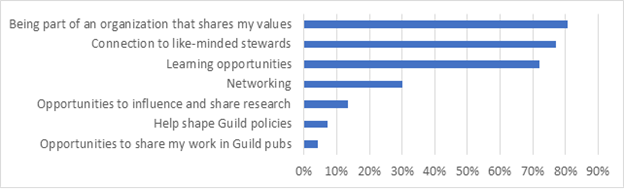
Not surprisingly, in our unique and learning community, when asked about the top three most valuable things about the Guild, 81 percent of respondents said, “Being part of an organization that shares my values.” Over 70% of respondents indicated the next two important values were “Connection to like-minded stewards” and “Learning opportunities” (see chart below).

Meeting Member’s Needs 
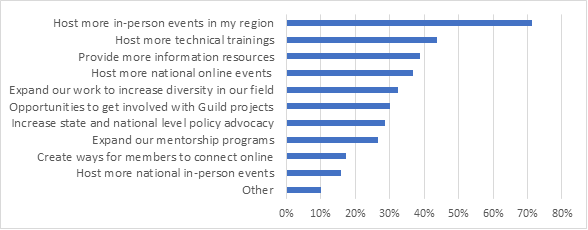
We asked about the top four ways the Guild can serve members better. Respondents focused on regional in-person events (71%), technical trainings (44%), information resources (39%), online events (37%), and efforts to increase diversity in forestry and conservation (32%). It is worth noting that national meetings were only in the top four things we can do to serve members better for 16% of respondents and policy for 29% of respondents.

Communicating with Members
In general respondents felt our e-newsletter (86%, monthly) and magazine (73%, twice per year) are sent at a good frequency. Most respondents had no opinion about social media posts.


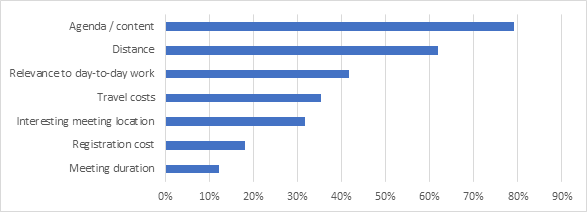
Most respondents were interested in quarterly (26%) or semi-annual (37%) regional conference calls. Similarly, most respondents were interested in monthly (36%) or quarterly (46%) webinars and annual (30%) or semi-annual (49%) in-person field events. Interest in attending meetings is inspired by the agenda and content (79%) followed by distance (62%) and relevance to day-to-day work (42%).

Stewardship topics 
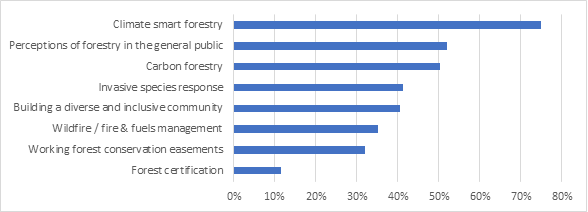
When asked what are the top four most pressing stewardship topics that you would like to learn more about, discuss, and work on, respondents focused primarily on climate smart forestry (75%) followed by perceptions of forestry in the general public (52%), carbon forestry (50%), invasive species response (41%) and building a diverse and inclusive stewardship community (40%).

What’s next?


Again, this is just a snapshot of what you shared. We received many thoughtful free-form comments and great ideas that we are considering along with the quantitative results. We also feel that answers in the minority hold great value, even though we didn’t report them in this summary. And although we don’t encourage “silos” in our work, we are paying attention to any regional nuance we find in the survey patterns of responses. We intend to continue learning and sharing from your responses as we go. Together, we will continue to expand our view, our perspectives, and our positive impact as we cultivate our best work in putting the forests first.

Already, Guild staff are busy connecting with members who want to and can help now, to improve our strategies and address the needs and topics you help us identify or confirm. Examples include planning for more opportunities to gather in each region, expanding active student involvement at the organizational level, and exploring how we can more effectively support a healthier future for forests not just directly, but through the impact of our stories and demonstrations. Our members’ abundant offers to help will make all of this more possible.

Thank you for all you do, and stay tuned!

Recent Posts

By Aidan Juhl April 16, 2026
Written by Colleen Robinson
April 14, 2026
Written by Shannon Maes
April 14, 2026
In September 2025, the Guild launched a three-person Forest Stewards Apprenticeship (FSA) crew to work with the Penobscot Nation’s Department of Natural Resources (PN DNR). Over the course of their six-month season, apprentices Agenor Duhon, Gabe Stewart, and Jacob Baker shared a season of learning, collaboration, and hands-on stewardship of Penobscot Tribal lands.
April 14, 2026
This week, I stepped into the role of crew leader. We worked a full 40-hour week, splitting our time between Clifton Farms and a prescribed burn operation. On the first day in the field, we completed hack-and-squirt treatments on trees that had been marked the previous week. For the remainder of the week, we focused on marking trees for future hack-and-squirt work, maintaining a steady pace and ensuring accuracy in our selections.
April 7, 2026
As Guild members, our practice is fundamentally grounded in field observation. We know intuitively that forests are dynamic, living communities. Yet, for decades, the high-level systems used to value our work, specifically the carbon accounting ledgers tied to international frameworks like the Paris Agreement, have treated forests as static, quantifiable blocks of land. In a recent commentary published in One Earth, I argue that these legacy measurement, reporting, and verification (MRV) frameworks are failing. Ledger accounting relies on crude land-use delineations and outdated technology, effectively penalizing the natural, seasonal flux of the ecosystems we manage every day. By forcing landscapes into rigid “forest” versus “non-forest” binaries, such legacy systems miss the complex reality on the ground. But a major shift is underway.
March 18, 2026
Women have always been a part of forestry. Historically, women often helped guide family decisions about when to cut, which trees to save, and how best to steward their land for the next generation. Historical accounts from the Southern Appalachians describe women’s roles in decisions about timber harvesting and prioritizing long-term forest health. These often-uncredited contributions are even reflected in Aldo Leopold’s A Sand County Almanac (1949), in which describes his stewardship philosophy informed not only by his professional experience, but by shared responsibility, where the perspectives of his wife and daughters played an important role.
March 18, 2026
Although rural regions often host the highest concentrations of public and private forest land, they typically lack the sustainable workforce necessary for active management and stewardship. How do we address this foundational problem in forest conservation?
March 18, 2026
The Forest Stewards Guild has a unique dual mandate: practice and promote forest stewardship. Personally, I think the combination of practicing forest management and promoting best practices is what makes the Guild a vibrant and impactful organization.
February 17, 2026
We celebrate the remarkable career and legacy of Leslie (Les) Benedict, who has provided visionary leadership and dedicated service to the stewardship of forests, championing the preservation of the ecological and culturally important black ash. Benedict, a member of the Saint Regis Mohawk Tribe in Akwesasne, north of the Adirondacks in upstate New York, recently retired after serving as the Assistant Director of the Tribe’s Environment Division for over 35 years.
February 17, 2026
The Forest Stewards Guild has been working to support the National Park Service on forest stewardship projects throughout the eastern U.S. This month we are in the midst of a project to protect mounds at Effigy Mounds National Monument near Harpers Ferry Iowa. This site was designated as a National Monument in 1949 and preserves over 200 mounds built between 800 and 2,500 years ago. Mounds at this site include conical, linear, compound, and effigy mounds – constructed in the shape of animals. Please see the National Park Service page for more information about the mounds, the people who built them, and how to visit the site. The lidar images on that website of the Marching Bears and other mound groups are fascinating.
Show More