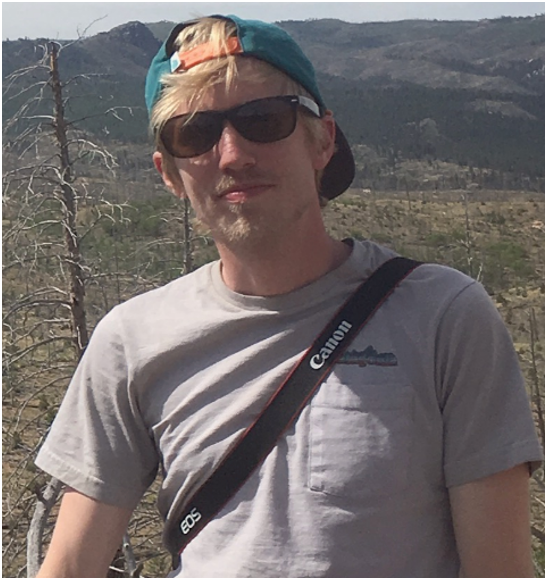
Meet Andreas Wion, Forest and Fire Science Manager
Written by Andreas Wion

I grew up on the outskirts of El Paso County, Colorado, along the foot of the Front Range. I spent a lot of time in my childhood hiking the empty quarters of the Air Force Academy. This was technically a felony trespass, but I think the statute of limitations has passed. I remember getting excited whenever I found bones or antlers hidden in the scrub oak. In 2012, this area burned at a high severity in the Waldo Canyon Fire, along with over 350 homes. That was when I first understood how important forest stewardship is, and how it can directly impact people’s lives and livelihoods.
To this end, I took jobs working for the federal government in the years between undergrad in Boulder and graduate school in Fort Collins. I worked as a Forest Service botanist in central Utah, built databases for the Food and Drug Administration in Maryland, and was an archaeologist in the Black Hills of South Dakota. I later enrolled in a graduate degree program in Ecology at Colorado State University, where I studied with Dr. Miranda Redmond in the Department of Forest and Rangeland Stewardship.
My research focused on masting – a phenomenon in which trees produce large seed crops in some years and no seeds in others. My dissertation aimed to answer a simple question: Why do trees mast? The reasoning being – if we can understand why trees mast, we should be able to predict where and when they will produce seeds. Although this seems like an obscure question, it bears greatly on our ability to manage forests. Forest regeneration depends on seeds – both natural regeneration and planted seedlings; it also affects wildlife communities and the diseases they carry, like Lyme’s disease and Hantavirus.
After grad school, I was a research fellow at the New Mexico Landscapes Field Station, where I learned how to read and interpret the stories that trees tell through their rings: droughts, fires, floods, and frost. I worked closely with Bandelier National Monument, co-producing actionable science that spanned tree die-off to type conversion to aerial seeding and fire modeling. Through it all, I’ve been asking myself – how do we best steward forests in an increasingly hotter world with larger, more frequent, and severe fires?
I don’t have a great answer for this question – but its what I will be working on at the Guild. I will support monitoring efforts across the Guild, particularly within the Rio Chama CFLRP, to develop scientific insights that I hope will move the needle on this question. I also hope to provide science support for various projects within the Guild – one of them being the Accelerating Science to Action Partnership (ASAP). Working with folks within the 232 Collaborative Landscape, I hope I can bridge the gap between science, management, and action. To this end, I would encourage you to reach out to me with any questions you might have about forest and fire science. Guild member or not – land manager or private homeowner – however you are reading this right now. Look me up and let’s talk about forest resilience. I hope to hear from you, and thanks for reading.
Andreas Wion
Forest and Fire Science Manager
Recent Posts