Good wood for lifetime members

January 16, 2025

Written by Zander Evans

Ryan Temple of Sustainable Northwest Wood

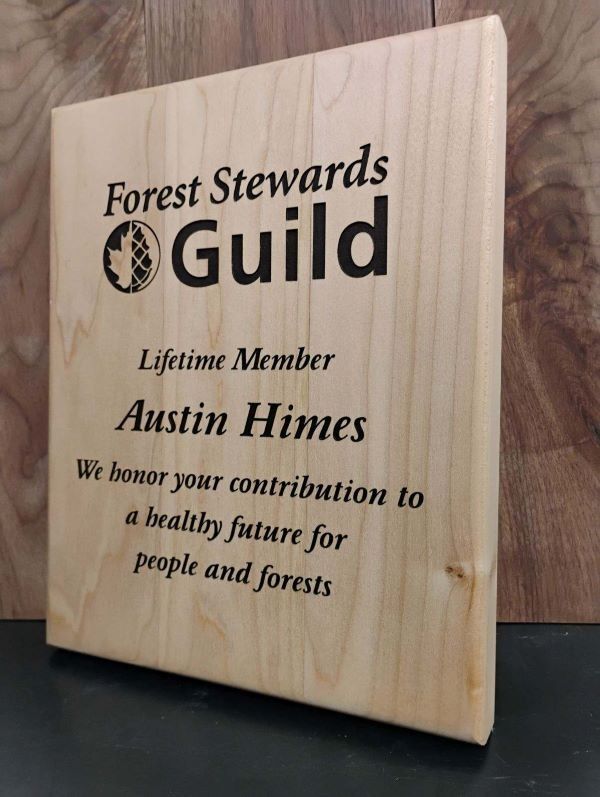
When the Guild wanted to provide plaques for our lifetime members, we knew just any old wood wouldn’t do. We needed wood from a well-managed forest. We needed to support sustainable industry. Sustainable Northwest Wood (SNW Wood) was an obvious choice.

At the recent Northwest Innovative Forestry Summit, Ryan Temple, founder and president of SNW Wood said, “Sure we can get you some nice, local wood for plaques.” Making the connection between customers and sustainable wood is exactly what SNW Wood has been doing for 15 years. Their goal is to make it easy to find local, sustainable, and Forest Stewardship Council (FSC) certified wood products. In this way, they are a bridge between responsible sourcing and the built environment. Sustainability is at the core of SNW Wood and connects their efforts to protect and restore ecosystems, to salvage and upcycle wood from the waste stream, and to create economic opportunities when supplying the wood products our community needs. One example is a signature program for SNW Wood, which uses western juniper (Juniperus occidentalis) from restoration thinnings. In the past, ranchers cut the trees and burned juniper as they restored the native grasslands, but today SNW Wood and other dedicated groups are nurturing markets to ensure that this beautiful wood is put to use. In general, the junipers that are cut and milled are the smaller, younger trees that have sprouted since fire suppression while the older, grander trees are left. In addition to providing naturally rot- and decay-resistant wood for decks, garden beds, and beautiful interior applications, the program provides jobs in rural communities. SNW Wood is part of Sustainable Northwest, a long time Guild partner. They work closely with other companies familiar to the Guild community such as Roseburg and Collins. 

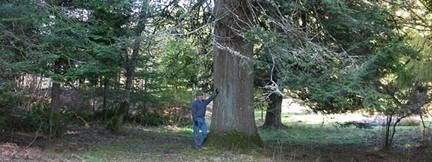
Photo of a A 5 foot diameter grand fir in the Wild Thyme Forest.

While we didn’t track individual logs, SNW Wood gets most of the big leaf maple like the pieces used for the lifetime member plaques from Northwest Hardwoods in Chehalis, Washington. It is all FSC mix credit certified from a diversity of landowners in southwest Washington. These are mostly small family forest owners and many of them are part of Northwest Natural Resource Group’s group FSC chain of custody. 

One family forest that has sent truckloads of big leaf maple to Northwest Hardwoods is Wild Thyme Farm near Oakville, Washington. John Henrikson is part of the family that manages Wild Thyme Farm and also attended the Northwest Innovative Forestry Summit. His philosophy will make sense to Guild members across the country: 

“Wild forest management involves maintaining our forest in the most natural and vigorous condition possible. Natural forestry allows high quality trees to grow to maturity. Timber is harvested from suppressed, damaged and downed trees. The ultimate objective is an ecosystem dominated by big trees with structural and biological diversity, while providing steady income from high quality, selectively harvested timber – attuned to nature’s own culling process.” 

Photo of a A 5 foot diameter grand fir in the Wild Thyme Forest.

The forest had been patch clear-cutting until the Henrikson’s acquired the parcel in 1987. Now it contains over 2 million board feet of timber in red alder, Douglas-fir, big leaf maple, western red cedar, western hemlock and grand fir. Wild Thyme estimates that over 100 years, their FSC-based management will result in 6,500 tons more carbon stored in their forests compared to conventional commercial harvesting. Wild Thyme is gearing up production and value-added processing so they will be able to provide maple and other species directly going forward (John also notes they are renovating their website so check back for an update on their management plan and lumber business).

All the connections and stewardship embodied within the bigleaf maple plaques make them a truly fitting marker of lifetime membership in the Guild. We honor the contributions our lifetime members make today, and for the future of forests, and appreciate SNW Wood’s products that help us express that to you! 

Recent Posts

By Aidan Juhl April 16, 2026
Written by Colleen Robinson
April 14, 2026
Written by Shannon Maes
April 14, 2026
In September 2025, the Guild launched a three-person Forest Stewards Apprenticeship (FSA) crew to work with the Penobscot Nation’s Department of Natural Resources (PN DNR). Over the course of their six-month season, apprentices Agenor Duhon, Gabe Stewart, and Jacob Baker shared a season of learning, collaboration, and hands-on stewardship of Penobscot Tribal lands.
April 14, 2026
This week, I stepped into the role of crew leader. We worked a full 40-hour week, splitting our time between Clifton Farms and a prescribed burn operation. On the first day in the field, we completed hack-and-squirt treatments on trees that had been marked the previous week. For the remainder of the week, we focused on marking trees for future hack-and-squirt work, maintaining a steady pace and ensuring accuracy in our selections.
April 7, 2026
As Guild members, our practice is fundamentally grounded in field observation. We know intuitively that forests are dynamic, living communities. Yet, for decades, the high-level systems used to value our work, specifically the carbon accounting ledgers tied to international frameworks like the Paris Agreement, have treated forests as static, quantifiable blocks of land. In a recent commentary published in One Earth, I argue that these legacy measurement, reporting, and verification (MRV) frameworks are failing. Ledger accounting relies on crude land-use delineations and outdated technology, effectively penalizing the natural, seasonal flux of the ecosystems we manage every day. By forcing landscapes into rigid “forest” versus “non-forest” binaries, such legacy systems miss the complex reality on the ground. But a major shift is underway.
March 18, 2026
Women have always been a part of forestry. Historically, women often helped guide family decisions about when to cut, which trees to save, and how best to steward their land for the next generation. Historical accounts from the Southern Appalachians describe women’s roles in decisions about timber harvesting and prioritizing long-term forest health. These often-uncredited contributions are even reflected in Aldo Leopold’s A Sand County Almanac (1949), in which describes his stewardship philosophy informed not only by his professional experience, but by shared responsibility, where the perspectives of his wife and daughters played an important role.
March 18, 2026
Although rural regions often host the highest concentrations of public and private forest land, they typically lack the sustainable workforce necessary for active management and stewardship. How do we address this foundational problem in forest conservation?
March 18, 2026
The Forest Stewards Guild has a unique dual mandate: practice and promote forest stewardship. Personally, I think the combination of practicing forest management and promoting best practices is what makes the Guild a vibrant and impactful organization.
February 17, 2026
We celebrate the remarkable career and legacy of Leslie (Les) Benedict, who has provided visionary leadership and dedicated service to the stewardship of forests, championing the preservation of the ecological and culturally important black ash. Benedict, a member of the Saint Regis Mohawk Tribe in Akwesasne, north of the Adirondacks in upstate New York, recently retired after serving as the Assistant Director of the Tribe’s Environment Division for over 35 years.
February 17, 2026
The Forest Stewards Guild has been working to support the National Park Service on forest stewardship projects throughout the eastern U.S. This month we are in the midst of a project to protect mounds at Effigy Mounds National Monument near Harpers Ferry Iowa. This site was designated as a National Monument in 1949 and preserves over 200 mounds built between 800 and 2,500 years ago. Mounds at this site include conical, linear, compound, and effigy mounds – constructed in the shape of animals. Please see the National Park Service page for more information about the mounds, the people who built them, and how to visit the site. The lidar images on that website of the Marching Bears and other mound groups are fascinating.
Show More