A return to burning as usual after everything has changed

February 16, 2023

The Glorieta Pile Burn in the Landscape of the Hermits Peak escaped prescribed burn 
Written by Carlos Saiz and Sam Berry 

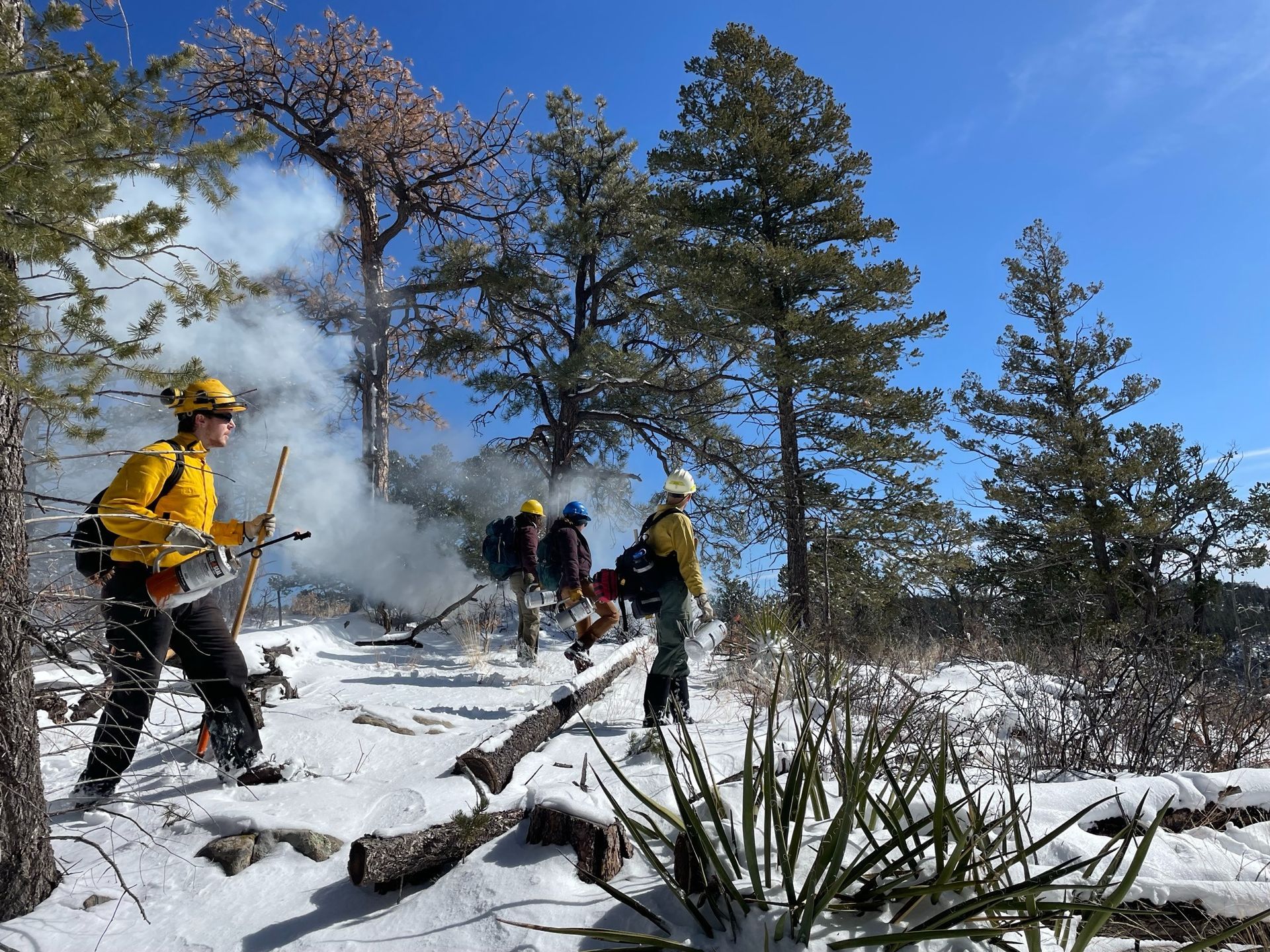
Fire crews finding piles to burn on the mountain.

The 2022 fire season was one for the history books in

New Mexico. I started with the Forest Stewards Guild as the Fire and Fuels Coordinator just after the Hermits Peak/Calf Canyon (HP/CC) Fire was ending. As this was the largest fire in the state’s history caused by 2 prescribed fires, New Mexicans were left extremely nervous when it comes to smoke in the forests, making my new responsibilities in prescribed fire a bit more challenging.

Glorieta Adventure Camps (the Camps) is located on over 2000 acres of forested land that has thousands of visitors each summer and is home to 100 full-time residents. It is located just to the southwest of the HP/CC fire. When thousands of people in northern New Mexico were pushed out of their homes because of the wildfire, the Camps took in many of the evacuees. Much like their surrounding neighbors, the Camps have been anxious about wildfires, and with so much at stake, they chose a proactive approach to wildfire resilience, including treatments such as thinning, masticating, and creating burn piles. 

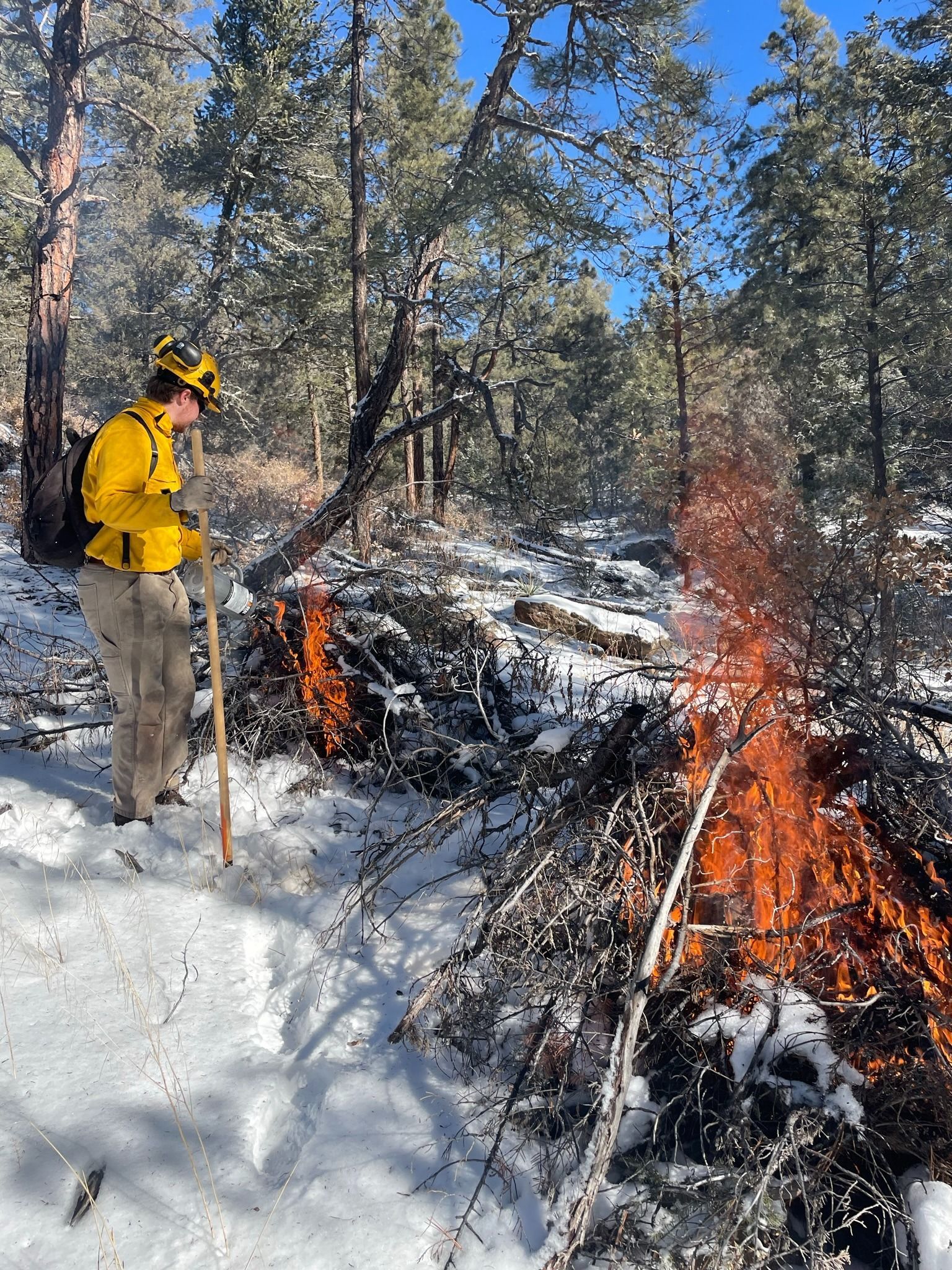
Starting in 2020 we combined efforts to begin pile burns. This is an effective way to reduce fuel loads in forests at risk for wildfires, lowering the severity of future wildfires and improving forest resilience. Led by our burn boss, Sam Berry, we have safely and successfully burned many acres of slash piles each year with our firefighters, partners, and Camp’s staff. Because the Camp is mostly south facing, snow comes and goes quickly, and our crews have had to go the extra mile to patrol and mop up pile burns in the days after each burn. 

After the devastating fire year in New Mexico, burning that had become routine faced new obstacles, such as public distrust of prescribed fire and anxiety from permitting agencies to allow burns. After securing the support of the district’s County Commissioner, we applied for a burn permit from the Santa Fe County Fire Department. They required us to revise our burn plan to meet the new US Forest Service requirements, which typically don’t apply to NGOs. Once these changes were complete and they had inspected the unit, they finally felt comfortable enough to issue us their blessing through a permit to proceed with the burn. 

Staff person watches over two pile burns.

To be transparent and to settle any concerns from locals, we doubled our communications efforts from previous seasons. We hosted a field tour to show our pile burn process at the camps. Despite numerous attempts to reach residents through local flyers and email blasts, this tour had few attendees. This left us wondering if the local community was unconcerned with the burn or if we hadn’t reached people. 

We also issued a press release that gathered attention following the catastrophe of the HP/CC wildfire. Newspaper articles and T.V. broadcast interviews helped spread the word that although we felt deeply for the victims of the fire, we believe the work of reintroducing fire is important enough to continue.   

One community leader that heard of the burn through a news story asked us, “Why?” Worry dominated our conversation and “Salt in the wound” was his initial reaction, but after a phone conversation and a field visit to discuss how and what we have accomplished at the Camps, worries were eased, and some trust was established. 

After the New Year, the storm we needed was in the forecast. It was our time to burn. The plan was to start with a small burn area to show that pile burning can still be done safely in the same area of the HP/CC fire. On January 19, 2023, “Prescribed Burn Ahead” signs appeared near the Camps and flyers were posted all around the community. On that snowy morning, our veteran firefighters led several burners with a mix of experience and affiliations, including some first-time burners. Reporters from the Albuquerque Journal also came to this first prescribed burn operation since spring 2022. With smoke in the air for the first time since the wildfires from escaped prescribed burns in the summer, our collaboration braced for comments from the community, but none appeared. A few days later the article appeared on the front page, announcing that we were leading the way with reintroducing prescribed fire. 

However, the actual work was not complete. The storm that allowed the first 8 acres of successful burning was followed by more with plenty of snow. 42 acres were left, and everything was lined up. On January 24th, as new and familiar faces gathered and geared-up, a phone call would change the pace for us. 

With light winds and snow on the ground, we called Santa Fe County Dispatch to get final permission to burn, and to notify them in case of smoke reports from the community. We were surprised to get a “no-go” message from the SFCFD battalion chief because of windy conditions in most of the county. Since we knew that our winds on the other side of the ridge were safe, a friendly partnership with SFCFD Wildland Division was called upon. “I will talk with the battalion chief and will get back to you,” was the message. The chief trusted us and our operations enough to explain the situation to his chief and to get an exemption for our burn. The green light was given. 

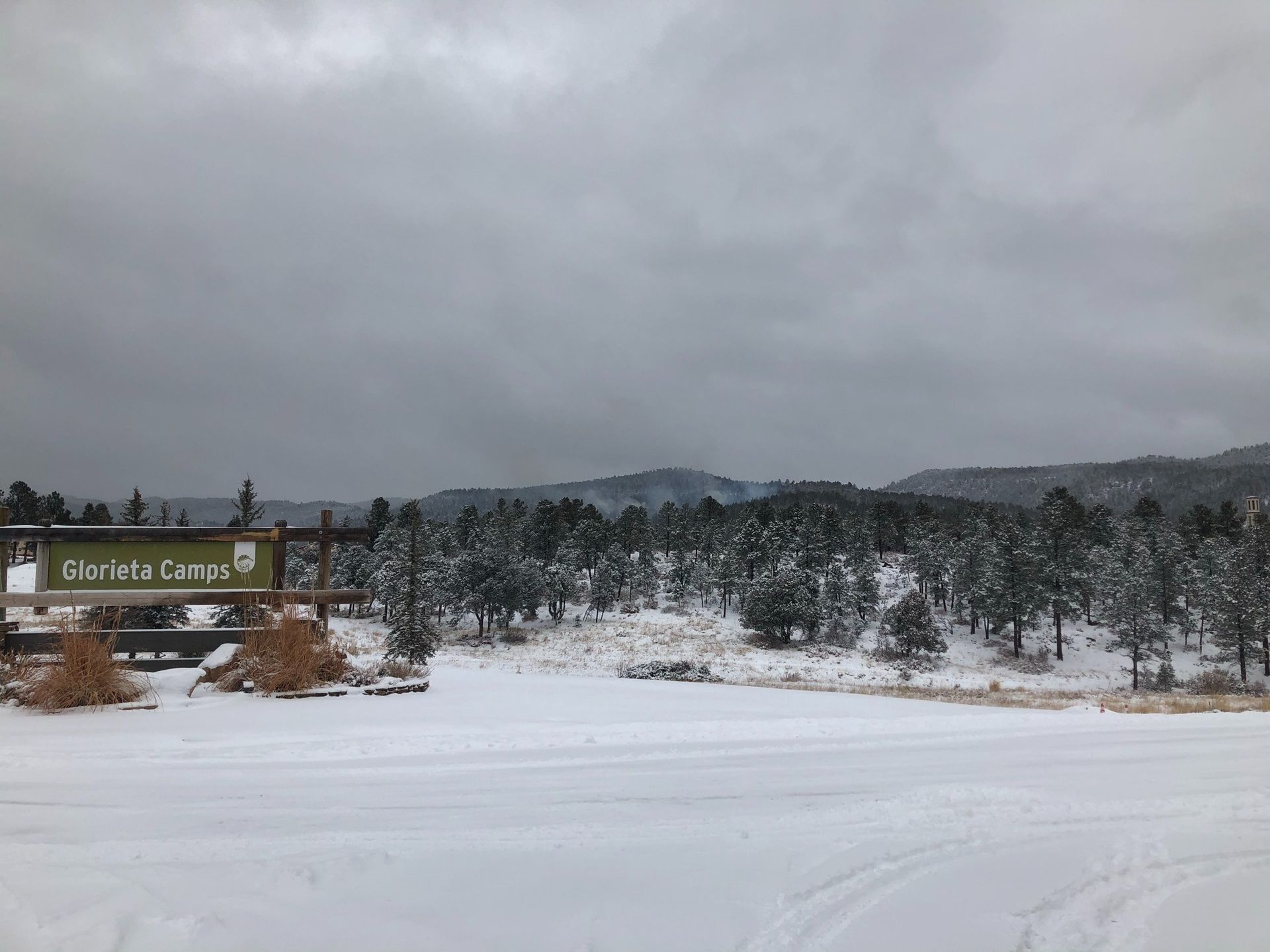
Smoke rises above Glorieta Camps from the first prescribed fire burn since 2022.

After the long hike up, and some training of many first-time burners, I lined out 16 burners on my first burn boss trainee assignment and we headed down the hill with lit drip torches and glowing smiles. 40 acres of piles were burned that first day, and the final 2 acres were burned the following day with some new snow on the unit. After more mop up and continued patrols the burn was called “out” February 6th, 2023. 

In the shadow of the devastating HP/CC fire, the Glorieta Camps Pile Rx faced major obstacles along the way. Between bureaucratic revisions, misunderstandings from community members, and a looming “shut down,” we overcame those adversities with the help of our partners, building on and creating long lasting partnerships, and trust within the community. With the help of Glorieta Adventure Camps we proved that prescribed fire can be done, together, and hopefully helped set the stage for the return of more prescribed fire in the mountains of New Mexico. 

Recent Posts

By Aidan Juhl April 16, 2026
Written by Colleen Robinson
April 14, 2026
Written by Shannon Maes
April 14, 2026
In September 2025, the Guild launched a three-person Forest Stewards Apprenticeship (FSA) crew to work with the Penobscot Nation’s Department of Natural Resources (PN DNR). Over the course of their six-month season, apprentices Agenor Duhon, Gabe Stewart, and Jacob Baker shared a season of learning, collaboration, and hands-on stewardship of Penobscot Tribal lands.
April 14, 2026
This week, I stepped into the role of crew leader. We worked a full 40-hour week, splitting our time between Clifton Farms and a prescribed burn operation. On the first day in the field, we completed hack-and-squirt treatments on trees that had been marked the previous week. For the remainder of the week, we focused on marking trees for future hack-and-squirt work, maintaining a steady pace and ensuring accuracy in our selections.
April 7, 2026
As Guild members, our practice is fundamentally grounded in field observation. We know intuitively that forests are dynamic, living communities. Yet, for decades, the high-level systems used to value our work, specifically the carbon accounting ledgers tied to international frameworks like the Paris Agreement, have treated forests as static, quantifiable blocks of land. In a recent commentary published in One Earth, I argue that these legacy measurement, reporting, and verification (MRV) frameworks are failing. Ledger accounting relies on crude land-use delineations and outdated technology, effectively penalizing the natural, seasonal flux of the ecosystems we manage every day. By forcing landscapes into rigid “forest” versus “non-forest” binaries, such legacy systems miss the complex reality on the ground. But a major shift is underway.
March 18, 2026
Women have always been a part of forestry. Historically, women often helped guide family decisions about when to cut, which trees to save, and how best to steward their land for the next generation. Historical accounts from the Southern Appalachians describe women’s roles in decisions about timber harvesting and prioritizing long-term forest health. These often-uncredited contributions are even reflected in Aldo Leopold’s A Sand County Almanac (1949), in which describes his stewardship philosophy informed not only by his professional experience, but by shared responsibility, where the perspectives of his wife and daughters played an important role.
March 18, 2026
Although rural regions often host the highest concentrations of public and private forest land, they typically lack the sustainable workforce necessary for active management and stewardship. How do we address this foundational problem in forest conservation?
March 18, 2026
The Forest Stewards Guild has a unique dual mandate: practice and promote forest stewardship. Personally, I think the combination of practicing forest management and promoting best practices is what makes the Guild a vibrant and impactful organization.
February 17, 2026
We celebrate the remarkable career and legacy of Leslie (Les) Benedict, who has provided visionary leadership and dedicated service to the stewardship of forests, championing the preservation of the ecological and culturally important black ash. Benedict, a member of the Saint Regis Mohawk Tribe in Akwesasne, north of the Adirondacks in upstate New York, recently retired after serving as the Assistant Director of the Tribe’s Environment Division for over 35 years.
February 17, 2026
The Forest Stewards Guild has been working to support the National Park Service on forest stewardship projects throughout the eastern U.S. This month we are in the midst of a project to protect mounds at Effigy Mounds National Monument near Harpers Ferry Iowa. This site was designated as a National Monument in 1949 and preserves over 200 mounds built between 800 and 2,500 years ago. Mounds at this site include conical, linear, compound, and effigy mounds – constructed in the shape of animals. Please see the National Park Service page for more information about the mounds, the people who built them, and how to visit the site. The lidar images on that website of the Marching Bears and other mound groups are fascinating.
Show More