
Shortleaf Pine Restoration
Cumberland Plateau shortleaf pine restoration
In the Cumberland Plateau of Tennessee and Kentucky, we have brought together key stakeholders to increase capacity for the restoration of fire-dependent shortleaf pine ecosystems. We:
- educate and reach out to landowners and natural resource professionals,
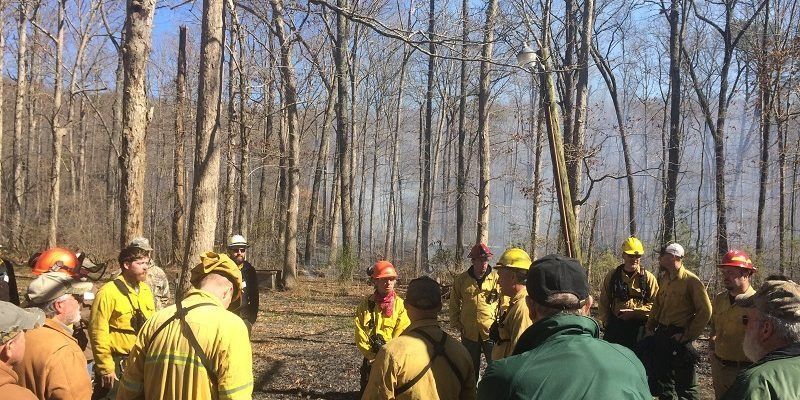
- host learn-and-burn events to engage private landowners in shortleaf restoration,
- develop NRCS-compliant shortleaf management plans to encourage restoration among strategic landowners, and
- support demonstration forests.
Shortleaf pine (Pinus echinata) currently occupies less than 10 percent of its historic range, with a 70 to 80 percent reduction in Tennessee and Kentucky alone. Across its range, more than 60 percent of remaining shortleaf pine forests are found on private forestland, making private landowners a key partner in restoring the species and its associated ecosystem.
Shortleaf pine is truly a flagship for multiple-use ecological forestry in the Mountains and Piedmont of the South, who’s ecosystem management supports important wildlife habitat, natural and biological diversity, increased resiliency, and high-quality timber products.
In partnership with the University of the South, Berea College, and the Tennessee Wildlife Federation, our goal is to enhance and restore habitat for shortleaf pine and oak woodlands by demonstrating the multiple benefits and techniques for responsible management.
Highlights
Press:
- Project at Savage Gulf State Natural Area leads work to restore Cumberland Plateau, Chattanooga Times Free Press, August 2019.
Partners
- National Fish and Wildlife Foundation
- Sewanee: the University of the South
- Berea College
- Tennessee Wildlife Federation
- Forest Stewards Guild's Gravitas Peak Fire Module
- Tennessee Department of Environment and Conservation (TDEC)
- Tennessee Wildlife Resources Agency
Shortleaf Pine Restoration Tool Kit
Resources for landowners and practitioners
What is the importance of shortleaf pine habitat?
What are key steps land managers and private landowners can take to ensure the long-term health of shortleaf pine habitat?
How can professionals effectively communicate the importance of fire adapted ecosystems to landowners and guide them in their actions?
This resources portal, or "toolkit" aims to help both landowners and practitioners achieve shortleaf restoration goals on property they own, manage, or care for.
Landowners
What is shortleaf pine?
How can I do this on my property?
Your first step is to write a forest management plan that incorporates shortleaf restoration activities such as harvest treatments and prescribed fire. Use these materials to help guide your process:
Who do I contact?
- Kentucky Division of Forestry
- Tennessee Division of Forestry
- Landowner specific page
- Shortleaf Pine Initiative
- The Guild is looking for landowners in KY to write management plans for. Contact us to learn more (dakota@forestguild.org)
Examples of restoration and technical resources
Natural Resource Practitioners
Silviculture and field tools
- Artificial Regeneration of Shortleaf Pine, Shortleaf Pine Initiative (PDF)
- Natural Regeneration of Shortleaf Pine, Shortleaf Pine Initiative (PDF)
- SPI Site Suitability and Decision Support Tool, Shortleaf Pine Initiative (PDF)
Research
- Modeling joint effects of harvest and fire regimes on shortleaf pine restoration (webinar)
- Vegetation response to canopy disturbance and season of burn during oak woodland and savanna restoration in Tennessee, (Vander Yacht et al. 2017)
- What fire frequency is appropriate for shortleaf pine regeneration and survival? ((Stambaugh et al. 2006).
Stay Informed
about our recent projects and upcoming events.